

Earth sciences professor co-authors study on Ekembo research in Kenya
 A recent study published in the journal Sedimentology by Tennessee Tech Earth Sciences
assistant professor Lauren Michel and an international team of collaborators has important
implications for how scientists think about the environments that early apes inhabited.
A recent study published in the journal Sedimentology by Tennessee Tech Earth Sciences
assistant professor Lauren Michel and an international team of collaborators has important
implications for how scientists think about the environments that early apes inhabited.
Michel and the team have been working on Rusinga Island in Kenya, a prominent site for research on early apes, for nearly 14 years. This island became famous in the 1930s and 1940s when paleoanthropologists Mary and Louis Leakey began work there. It was during this time that their team of local Kenyans and international collaborators discovered some of the most iconic specimens associated with the evolution of apes, including numerous specimens of an ape called Ekembo.
Since then, many groups of scientists have tried to reconstruct the environments that Ekembo and its contemporaries inhabited.
“Although abundant fossils (of plants and animals) were found over the last century on Rusinga Island, previous scientists’ interpretations in term of paleoenvironment were never consistent from one study to another,” explained co-author Thomas Lehmann, head of the palaeomammology section at the Senckenbergy Research Institute and Natural History Museum in Frankfurt, Germany.
“We know now that the difference in interpretations were because previous workers thought that all of the fossils in the formation we studied were the same age, which we documented was incorrect. This meant that previous work sampled fossils from different intervals of time that were from very different environments or because the mixed fossils are different ages, and different environments together,” added co-author Daniel Peppe, associate professor in geosciences at Baylor University.
“The research that my colleagues and I are working on shows approximately 20 million years ago there were parts of East Africa that transitioned from open to more closed environments,” said Michel. “This study, along with a number of other recent studies, demonstrates that there were open environments present when early apes were living, and that there was not a linear transition from closed to open environments, broadly across Africa. This is important because there is an old trope that suggests 20 million years ago all of Africa was a closed canopy forest which linearly transitioned to the open savannahs that are common in East Africa today.”
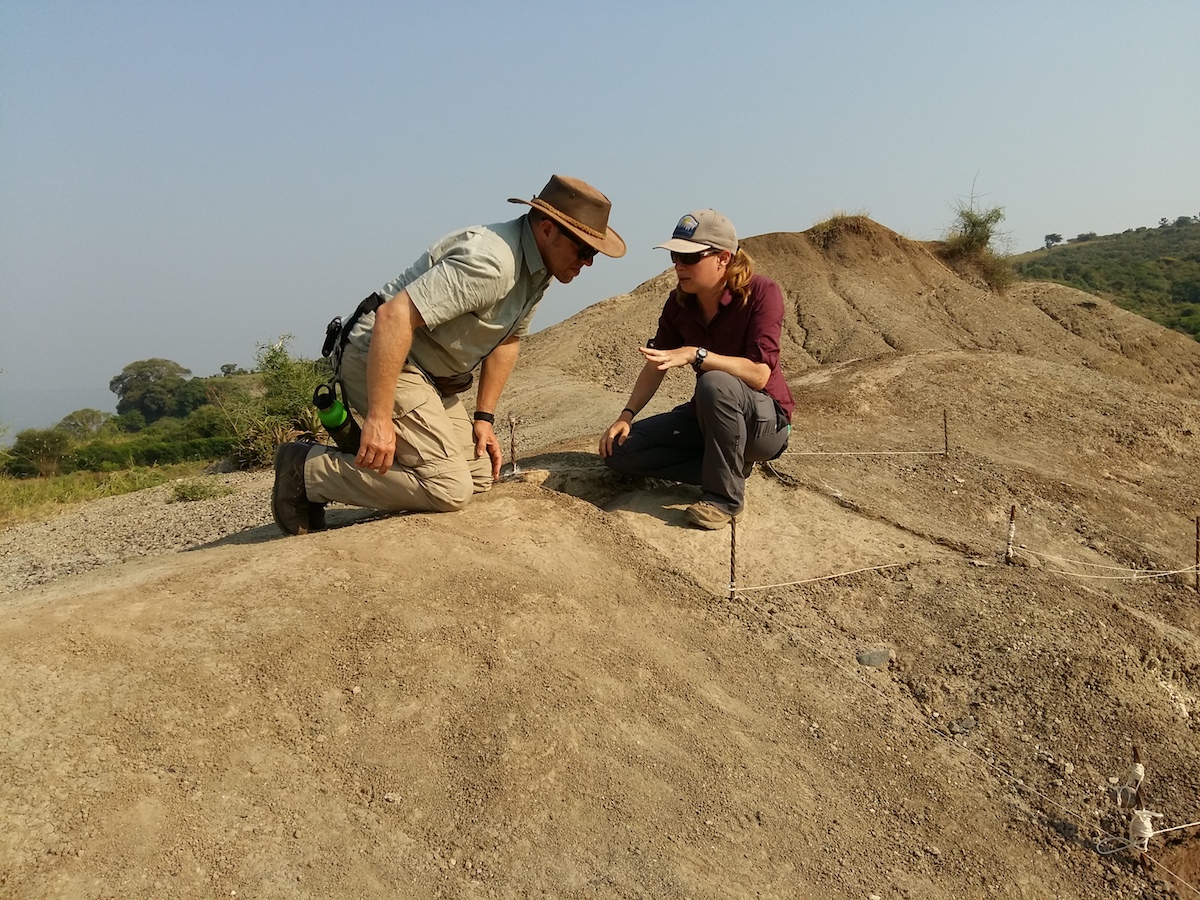
One way the team was able to document this transition was through systematic archeological-style excavations and differential GPS mapping.
“This enabled researchers to put all these animals in very precise geologic contexts, said co-author Kirsten Jenkins, an assistant professor of anthropology at Tacoma Community College. “These little details are what allow us to approach big picture questions about the environments in which these animals lived.”
“We were able to place new fossil collections and excavations by our team into a stratigraphic framework,” Michel said. “Then we used fossilized soils or paleosols and sedimentary features to reconstruct environment. In the past few years we had discovered different layers that showed evidence of high rates of evaporation, fossil plant roots, and even a fossil forest.”
“In the end, the team was able to document at a single site the transition over time from a drier, more open environment to a wetter, more closed environment,” said Kieran McNulty, professor of anthropology at the University of Minnesota and another collaborator on the project.
“Importantly, this is documented at one single locality, not spread over several geographic regions, the environmental change is in the opposite direction as one might have predicted and the well-known early fossil ape Ekembo is found across that environmental transition,” continued McNulty. “As a result, this work shows that simplistic models of the types of habitats associated with the early evolution of the ape-human lineage are probably not valid.”