

Tech graduate students, faculty explore rural and indigenous communities in preparation for $3 million grant project
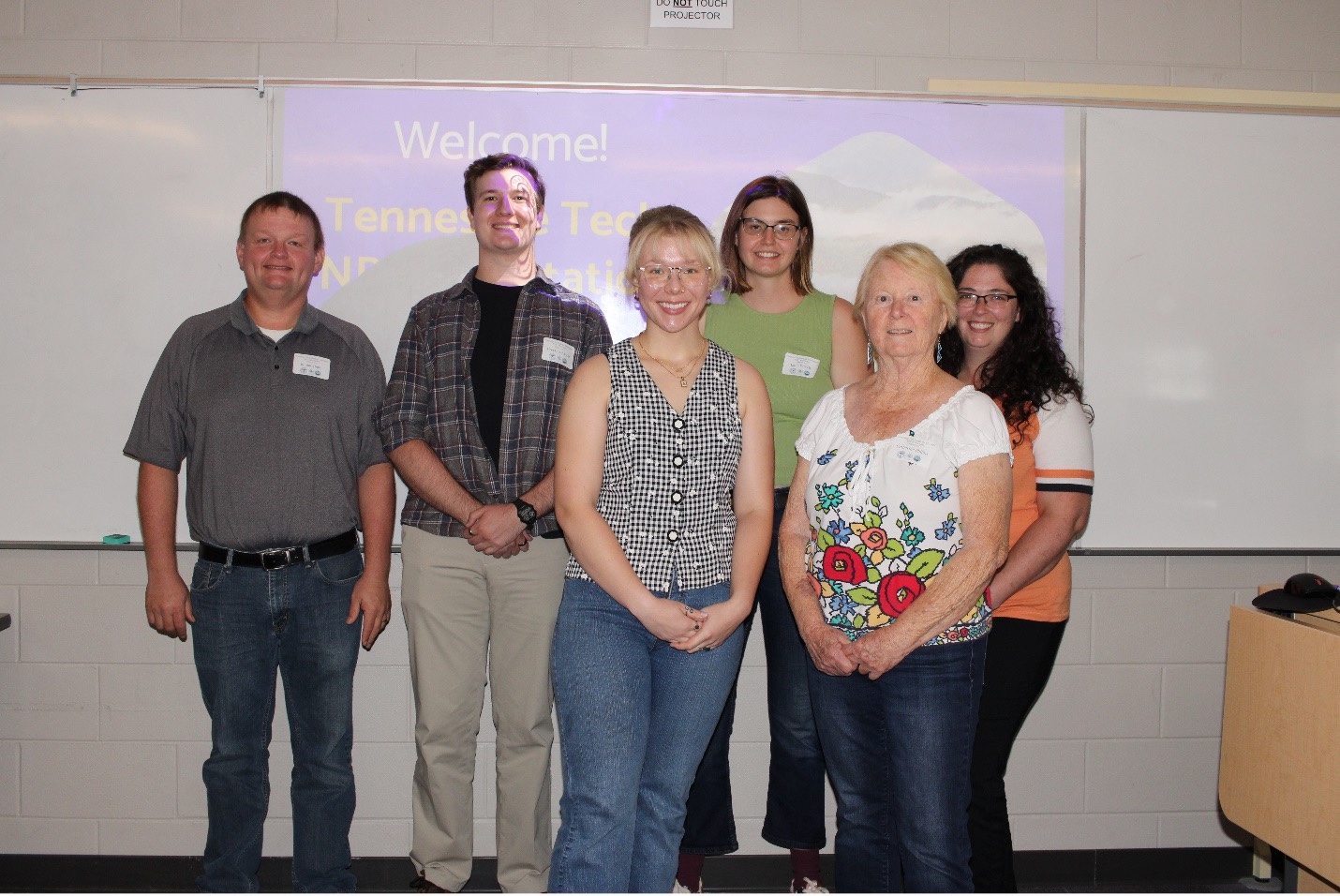
Tech graduate students involved in the project include, from left, Ronnie Dunn, Creek
Anderson, Jessee Griffith, Katie Pabody, Catherine “Kitty” Philips and Carey Wilson.
A group of Tennessee Tech University graduate students and faculty recently embarked
on an immersive four-day trip into the history and culture of Cherokee, Appalachian
and other rural communities across Tennessee, North Carolina and Georgia. The trip
was organized as part of the new "Engendering the Spirit of Gadugi at the Food-Energy-Water
Nexus" program at Tech, which received a $3 million grant from the National Science
Foundation’s National Research Traineeship Program (NSF-NRT) last year.
“For some of the students, this was their first time seeing the mountains and going
into a lot of these historic sites,” said Sabrina Buer, who has a Ph.D. in environmental
sciences at Tech, and is the project’s coordinator. “It was different from a lot of
the school trips that people go on where you just pop into a museum, poke around a
bit and then leave. We had along people who were experts in these fields and who could
give so much more context than what you would normally get.”
The goal of the project is for graduate students to partner with these communities
to collaborate and learn together in solving challenges the communities face in food,
energy and water access. In addition to collaborating with these communities, students
will also be learning skills associated with problem-identification and problem-solving
while working with complex, societal and technological challenges. This is reflected
in the program’s name. The term ‘Gadugi’ comes from the Cherokee language and refers
to working together, usually as a community, to benefit everyone.
The project involves research and collaborators from five different colleges: Agriculture
and Human Ecology, Arts and Sciences, Education, Engineering and Interdisciplinary
Studies. The project also has the support and/or collaboration from Tech’s Rural Reimagined
Grand Challenge, The Center for Energy Systems Research, the Water Center, the Center
for Assessment and Improvement of Learning and The Upper Cumberland Humanities and
Social Sciences Institute.
The trip took students to visit museums, historic sites and memorials important to
understanding the experience of the partner communities. The immersive experience
was the brainchild of Troy Smith, associate professor of history, supported by Ada
Haynes, professor of sociology and political sciences, and Andrea Arce-Trigatti, an
education consultant for the NSF-NRT project and member of the Renaissance Foundry
Research Group at Tech. In addition to these and Buer, other Tech faculty who joined
the students on their journey included: Robby Sanders, interim chair of chemical engineering;
Rufaro Chitiyo, assistant professor of human ecology and Pedro Arce, professor of
chemical engineering and project principal investigator.
There are currently six NSF-NRT supported students currently involved in the program:
Creek Anderson, Ronnie Dunn, Jessee Griffith, Katie Pabody, Catherine Philips and
Carey Wilson, and five were able to take part in the recent trip. All of the students
are either working on their master’s or Ph.D. and come from disciplines including
professional science, environmental sciences, biology and exceptional education. Pabody,
Philips and Anderson also recently gave a presentation on the highlights of the trip
at the October national NSF-NRT meeting in Arizona.
During their multi-state excursion, the group traveled to a number of educational
sites, including the Museum of Appalachia in Clinton, Tenn.; the Highlander Research
and Education Center in New Market, Tenn.; the Museum of the Cherokee Indian in Cherokee,
N.C.; Fort Loudoun State Historic Park and the Sequoyah Birthplace Museum in Vonore,
Tenn.; the Cherokee Removal Park in Birchwood, Tenn.; the Nancy Ward Gravesite Park
and Red Clay State Park in Cleveland, Tenn.; the Chief Vann House Historic Site in
Chatsworth, Ga.; and the Etowah Indian Mounds State Historic Site in Cartersville,
Ga.
“One of the things that was really surprising to me, and exciting as an educator,
is that the students didn’t seem to want to end the trip. When we got to the end,
they asked, ‘Are you sure this is all? Isn’t there anywhere else we can go?’ That
was really wonderful to hear,” said Arce.
This immersive trip into the partnering communities provided crucial background and
context for students before they begin their projects. Before they could identify
what problems to solve around food, water and energy, the students needed to understand
the histories of the people they want to help. It’s part of the Renaissance Foundry
Model of learning spearheaded by Arce and his collaborators that facilitates the development
of critical thinking and other skills through implementation of innovation-driven
learning approaches.
“It is teaching them how to identify problems and also community integration,” Buer
explained. “It teaches how you respectfully approach a community and work with them
on problems without coming across as ‘I know more about your community than you do.
This is the problem you have and I'm your superhero.’ It’s teaching them how to interact
respectfully with community members. Also, they can see these communities firsthand
instead of through a textbook.”
This semester the students have been learning about the communities and their histories
as well as acquiring knowledge and skills about the three key aspects of the program:
Innovation-driven learning, critical thinking skills and assessment, and community
needs. Next steps will be to start making connections with real people who live in
these rural and indigenous populations and learning what kinds of problems they face
around food, water and energy. From there, the plan is for the students to break into
groups and start working together to brainstorm and start developing prototypes for
solutions that are fully integrated into the communities.
“We are getting their feet wet this semester. The next semester they are maybe going
to go waist deep, and then after that, it will be time to swim,” Buer said.