

Tech to offer B.S. in music with live audio degree option
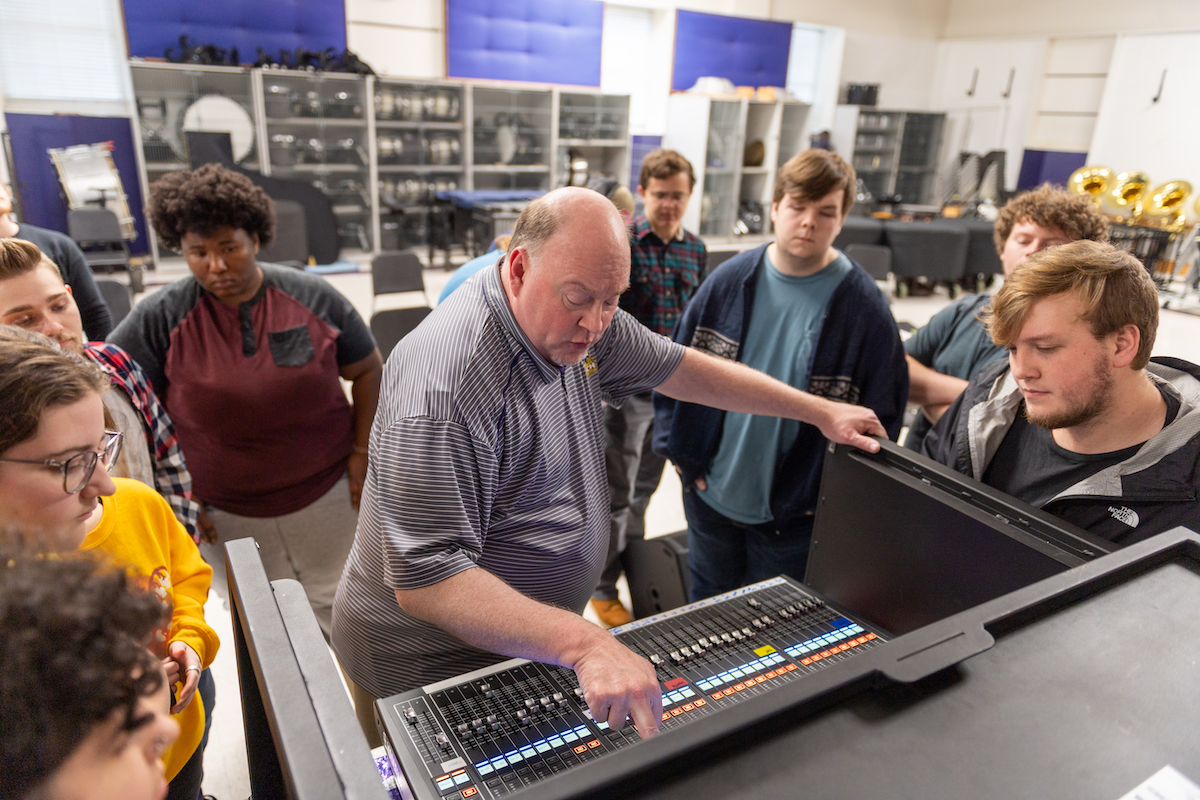
Eric Harris, professor of music, demonstrates some of the technology used with live
audio events to his class at Tennessee Tech.
Starting this fall, Tennessee Tech University will offer a bachelor of science in
music with a degree option that focuses on live audio. The curriculum is designed
specifically to train students for future careers in the live performance industry
as audio engineers – mixing sound for live events which might include concerts for
touring musicians, theatrical productions and services for large houses of worship.
“We created the bachelor of science in music because we had students who wanted to
be involved with music, but didn't really fit the traditional models of someone wanting
to be a K-12 educator or wanting to be a professional performing musician,” said Colin
Hill, doctor of musical arts (DMA), director of Tech’s School of Music. “This degree
will allow students to prepare for careers in the commercial music industry.”
The idea to focus on live audio came from Eric Harris, DMA, Tech music professor,
who has experience in mixing audio for a large theme park’s productions. He’d seen
first-hand how great the need was for people with the knowledge and skills to run
and maintain the complicated audio systems that make live events work.
“It turns out that there's been a shift in the music industry,” Hill said. “Artists
are not making the bulk of their money from selling albums anymore. They are making
that revenue from the sale of tickets for live events, and in order to draw in larger
audiences, the technology involved has rapidly expanded. Lighting, audio, digital
video, wireless and power distribution technologies have advanced to levels that were
previously unimaginable. Industry research shows that for every one job there is in
the recording studio industry, there’s nine jobs in live audio.”
Tech’s new live audio degree option has been developed in close collaboration with
other departments across campus, including electrical and computer engineering, mathematics,
physics, computer science and chemistry. Hill and Harris also reached out to industry
professionals in Nashville, seeking guidance and feedback as the curriculum was being
developed.
“Dan Heins, regional vice president for Clair Global, the world’s largest tour audio
company, has been incredibly kind and generous with his wisdom and advice as we built
this new degree option,” Harris said. “We’ve also met with the audio engineering team
at Bridgestone Arena.”
Students in this degree option will earn a minor in electrical and computer engineering.
This minor was developed by the faculty of the department of electrical and computer
engineering. Students will take other advanced math and science classes, including
calculus, acoustics and general chemistry – all while completing the courses required
for a college music degree.
“Dr. Colin Hills’s work on behalf of this new degree has been amazing,” Harris said.
“Rarely a week goes by in which we do not meet to discuss some aspect of this new
degree option. He’s been an exceptional leader and collaborator.”
According to Harris, this new degree option would not be possible without the guidance
and collaboration of Alan McKenzie, Ph.D., chair of the department of electrical and
computer engineering; Michael Allen, Ph.D., interim chair of the department of mathematics;
Steve Robinson, Ph.D., chair of the department of physics; Jeff Boles, Ph.D., chair
of the department of chemistry; and Gerald Gannod, Ph.D., chair of the department
of computer science.
“Provost Dr. Lori Bruce has been very supportive as well,” Harris said. “And most
important was the interest of Dr. Jennifer Shank, dean of the college of fine arts,
in creating this new program. Without her vision, none of this would have been possible.”
“There has been this incredible collaborative energy and enthusiasm shown all across
campus for this new degree option,” he added. “We’re so excited about this new opportunity
and believe that Tech can become a national center for excellence in the training
of professionals for the live audio industry.”