

Blind Tennessee Tech journalism, WTTU alumna reflects on college years that led to radio success
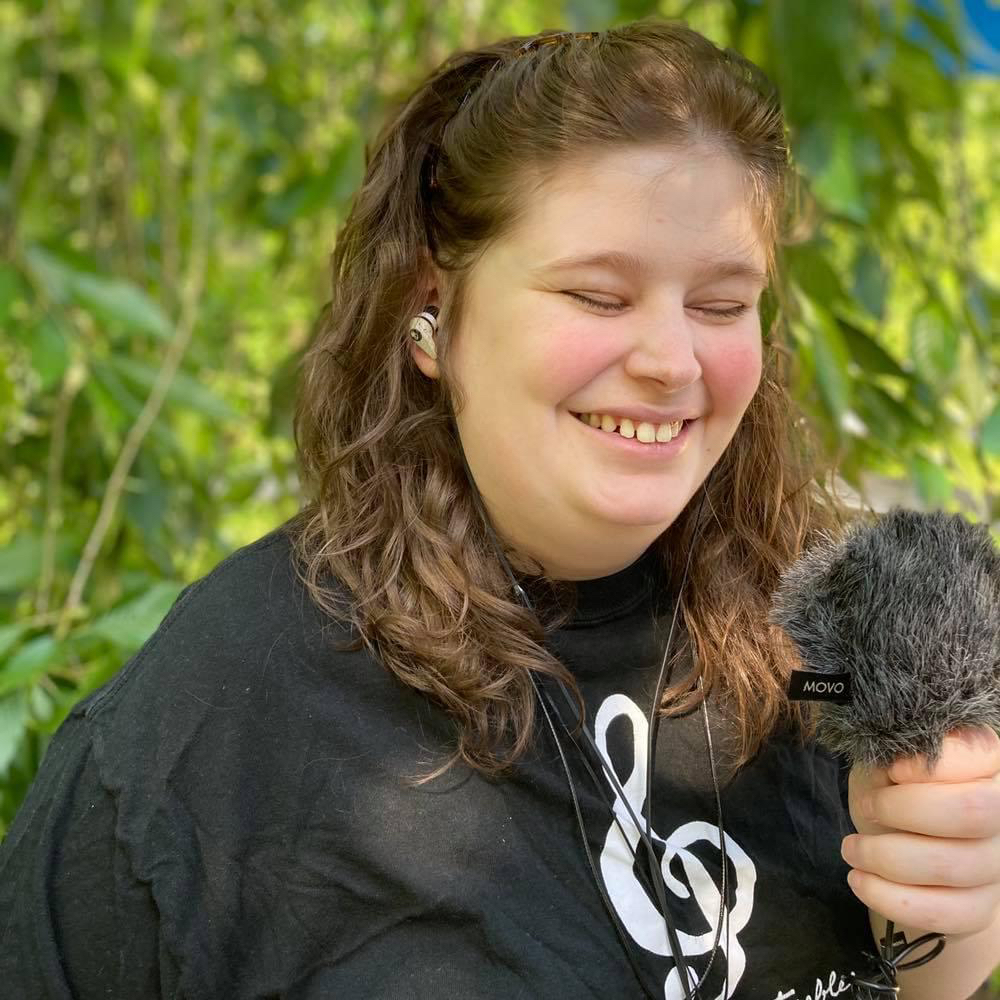
Radio host and Tennessee Tech journalism alumna Emily Paton is pictured holding her microphone outside her home in Cookeville.
When Tennessee Tech University journalism alumna Emily Paton first toured campus in
2016, it immediately felt like home. After a visit to the WTTU-FM student radio station’s
quarters atop the Roaden University Center, the aspiring broadcaster knew she was
ready to enroll.
But Paton didn’t see any of campus that day. The Pennsylvania native was born with complete loss of sight
and instead relied on the feel of the DJ booth, the kindness of Tech students and
faculty and the sounds of the university’s bustling main quad to know she was exactly
where she needed to be.
Once at Tech, Paton refused to let her disability slow her down. While navigating
campus without sight posed its challenges, she came to know buildings such as the
University Center and Henderson Hall like the back of her hand.
Paton quickly signed up for a hosting slot at WTTU, something she now sees as the
single most valuable part of her experience at Tech. Her student colleagues at the
radio station devised an accommodation that allowed Paton to build out her radio shows
on her phone, bypassing the DJ booth’s many knobs and dials.
“I just made the playlist of what I wanted to air on my phone and hooked it up to
my computer,” she recalled.
Paton’s music genre of choice was alternative rock. Artists like The Cranberries,
The Strokes and The White Stripes got heavy airtime.
“It’s the music that I grew up with,” she explained. “Alternative rock is very underrated
in my opinion. I wanted to make sure that was getting some more love.”
In her journalism courses, Paton says she learned the values of unbiased reporting
and a commitment to the facts. She recalls Tech faculty like Colleen Mestayer, Scott
Christen and former lecturer Christine Sieber as being particularly influential on
her college journey – even on days when it felt like her blindness and her studies
were on a collision course.
“I remember one day during COVID when we were meeting over Zoom. The meeting password
kept changing to an auto-generated password with all these numbers and characters,”
said Paton. “I ended up missing class that day. Dr. Mestayer called and personally
caught me up on everything. She was one of my favorites.”
These days, Paton is putting her Tech degree to work as the host of two internet radio
shows. “The Forgotten Song Project” airs weekly on VENOM FM, a streaming platform
run primarily by other blind broadcasters, and on WAKI internet radio in Annapolis,
Md. Likewise, “The Emily Paton Show” – a marathon four-hour daily broadcast – airs
online via NEWHD Radio.
Ultimately, Paton hopes to get her shows syndicated to a wider audience and to own
an alternative rock station. And while she is aware that her story may be a source
of inspiration to many, she wants to be sure it’s for the right reasons.
“People will sometimes say ‘you’re an inspiration because you’re blind’ – but I’d
rather people be inspired by what I do versus being inspired by my disability,” said
Paton. “My blindness is just part of who I am.”
Paton adds that her years in the classroom and as a radio personality have given her
perspective when it comes to living with a disability and overcoming challenges. Now,
she wants others who may be coming to terms with a disability of their own to know
that the show must go on.
“Your life is not over. You just have to find ways around it,” said Paton. “I truly
believe if I woke up tomorrow with sight, I’d feel the same.”