
Campus and community come together for CityScape tour of Tennessee Tech foundry
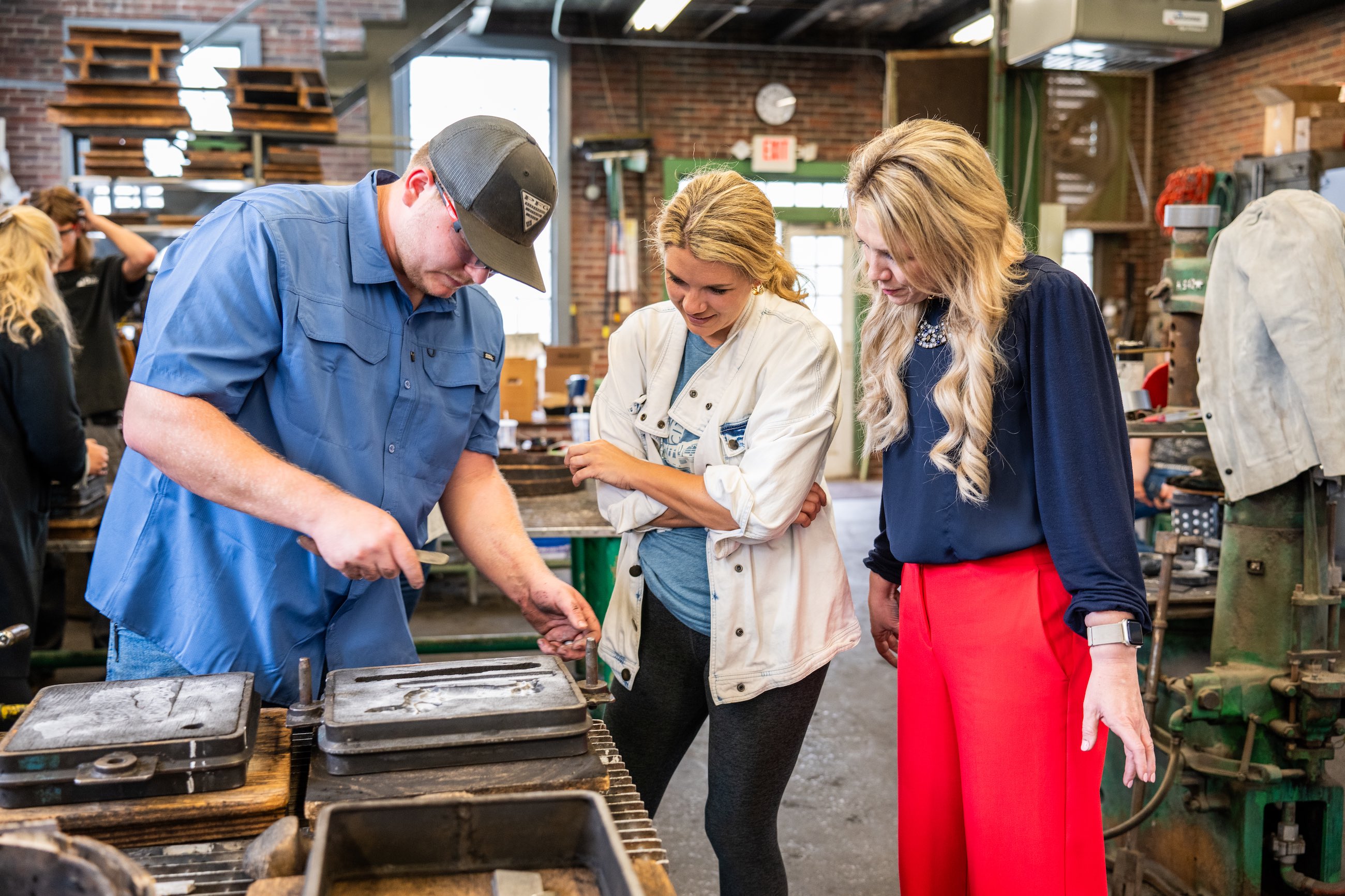
CityScape executive director Ferran Kefauver, center, and board member Hannah Davis,
right, receive a sand casting demonstration during CityScape's recent tour of Tech's
foundry.
Tennessee Tech University’s Department of Manufacturing and Engineering Technology
recently brought the campus together with the community by offering CityScape board
members a tour of its foundry.
Fred Vondra, chair of the department who met with the CityScape board during its tour,
said foundry work – such as metal casting and shaping – isn’t often what people think
of when they hear the word "engineering."
But from the cars we drive, the machines we use for work and appliances we use in
our homes, foundries literally provide the nuts and bolts that hold our lives together.
“Many people don’t really know what metal casting is, but when they see it, they’re
amazed,” he said.
That’s exactly what happened when the CityScape board toured Tech’s foundry. Members
of the community nonprofit, which works to preserve and promote Cookeville’s historic
downtown, got an up-close look at how some of the university’s students are learning
to design and produce essential components for industries across the country.
“It was incredible! The skill and professionalism of the students who gave demonstrations
that day were second to none,” said Ferran Kefauver, CityScape executive director.
“Each time I see a part of Tech that I haven’t seen before, I’m always blown away
by the talent of the students, and this tour lived up to that pattern.”
The students designed and cast a piece that combined Tech’s and CityScape’s logos
as a souvenir for each tour participant, and some were made using 3D modeling.
A 3D printed pattern of the CityScape logo was created by the American Foundry Society
Student Chapter.
“The College of Engineering – and the entire university – offer incredible resources
and opportunities that many in our community may not be familiar with,” said Susan
Luna-Hazlewood, director of Tech’s Crawford Alumni Center and CityScape board member.
Vondra explained that metal casting is the sixth largest industry in the U.S., despite
it seeming like “the world’s best kept secret.”
Luna-Hazlewood said the experience sparked important conversations among board members
about civic engagements, nonprofit leadership and CityScape’s mission to enhance Cookeville’s
historic charm.
“Hosting CityScape board members at Tech’s foundry was an invaluable opportunity to
showcase the talent of Tech’s students, faculty and cutting-edge programs. I look
forward to many more opportunities to connect the university and the Upper Cumberland
community,” she said.
The timing was ideal, Luna-Hazlewood continued, because the nonprofit organization
also recently hosted its annual Taste of the Town fundraising event in the university’s
new Ashraf Islam Engineering Building, welcoming nearly 600 community members into
the newest state-of-the-art facility on campus.
The connection between CityScape and Tennessee Tech reflects a growing collaboration
between the university and local organizations in the Cookeville community, campus
administrators say.
Since 1991, CityScape has worked to preserve and enhance Cookeville’s historic downtown,
with a focus on community livability, economic revitalization and historic preservation.
The organization collaborates closely with city and county governments, business owners
and civic groups.
Through the work of the organization, Cookeville is an accredited Tennessee Main Street
community, a designation made through the National Main Street Center and the National
Trust for Historic Preservation.
The foundry tour helped board members understand just how deeply the university’s
contributions extend into Cookeville’s past – and into its future.
One example: the CityScape logo features a historic steam locomotive, a nod to the
rail lines that helped shape Cookeville’s identity. That locomotive, a local landmark
housed outside the Cookeville Depot Museum, includes metal components cast and restored
by students and faculty at Tech’s foundry.
“There’s something fascinating about the metal casting process. It’s not just about
pouring metal; it’s about knowing the industry’s current capabilities and being able
to envision the future of manufacturing,” Vondra said.
“Anytime someone’s interested in this field, I find it enjoyable to share what we
do,” he continued.
In the 1970s, more than 10,000 working foundries existed in the U.S. While that number
has been reduced to about 2,000, the rise of automation and other advanced technologies
means modern foundries produce significantly more output, Vondra said.
“From an educational standpoint, foundries are the foundation of manufacturing and
engineering technologies, but from a community standpoint, they’re important too.
We want people to understand the value, and the opportunity, the foundry represents,”
he said.
Luna-Hazlewood agreed. “Events like this show what can happen when the community and
university come together. We’re building something stronger, together,” she said.
Tech's foundry will soon get an all-new home and expanded range of capabilities inside the soon-to-be-built Advanced Construction and Manufacturing Engineering (ACME) Building. The new facility will nearly double the size of the current foundry. Learn more at https://www.tntech.edu/engineering/news/watchusgrow.php.