
Tennessee Tech CEROC team takes 2nd at Collegiate Cyber Defense competition qualifier
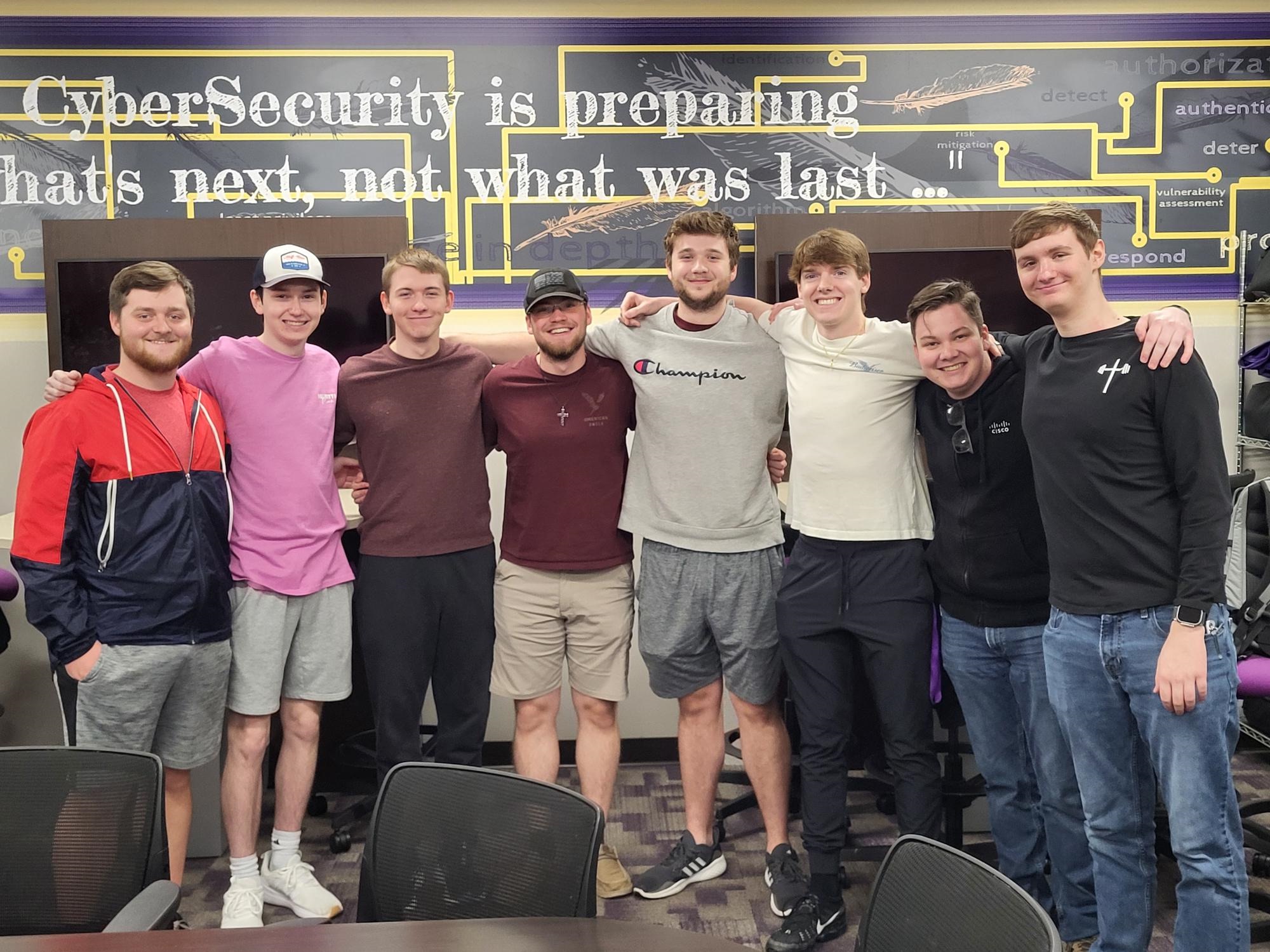
Students from Tennessee Tech’s Cybersecurity Education, Research and Outreach Center
(CEROC) pictured for the 2024 Collegiate Cyber Defense competition. From left: Micah
Jones, Landon Crabtree, John Brentlinger, Joey Milton, John Ognibene, Brett Billingsley,
Nate Dunlap and Landon Byrge.
Tennessee Tech University’s Cybersecurity Education, Research and Outreach Center
(CEROC)’s Collegiate Cyber Defense Competition (CCDC) team took second place in the
qualifier for the regional Collegiate Cyber Defense competition earlier this month.
A total of 36 teams competed in the event. This year's outcome qualifies the team
for regionals which will be held at the Kennedy Space Center on March 23-24, 2024.
CCDC is a defensive security competition where teams focus on defending a commercial
network from a team of professional penetration testers.
“This competition is like trying to sail a ship that is continuously springing leaks
and catching fire as they are securing and maintaining machines and services while
also being attacked by an active team. This team demonstrated the necessary technical
skill and calm mindset to constantly plug the leaks and douse the fires to restore
services, keep them running, and block further attacks,” said Jeremy Potts, CEROC
cyber range engineer and room judge.
“Our team did a great job of showing the timeliness, professionalism, and skill that
defensive security specialists are capable of, and we look forward to competing against
the top southeast CCDC teams at regionals,” added Travis Lee, CEROC cyber range engineer
and team coach.
In computer security, blue teams (or defensive security teams) are given an infrastructure
consisting of multiple computers that run various types of services. The teams’ goal
is to keep those services operational for as long as they can. Red teams (or offensive
security teams) are responsible for conducting attacks against the infrastructure
to identify weaknesses and bring down those services. These blue team / red team competitions
allow both sides to develop their cyber skills further and use this knowledge to defend
current commercial systems.
“These student teams continue to amaze us with their abilities. The depth of support
within the student-led cyber community at Tennessee Tech is on display every time
one of our teams takes the field. We are very proud of their accomplishment,” said
Eric Brown, associate director for workforce development at CEROC.
A longtime leader in cybersecurity issues, Tennessee Tech was selected by the National
Security Agency (NSA) and National Science Foundation (NSF) as the sole GenCyber campsite
in Tennessee in 2023 and hosts the first and largest CyberCorps SFS program in the
state. Tech is additionally recognized as a center of academic excellence in cybersecurity
by the NSA. The university is home to the Golden Eagle Cyber Certificate program,
a dual enrollment program allowing high school students to take college-level cybersecurity
courses contributing to their post-secondary work.
CEROC focuses on K-20 cybersecurity education programs, research in emerging cybersecurity
topics, and outreach programs to stakeholders in academia, government, and industry.
Learn more at www.tntech.edu/ceroc or by emailing ceroc@tntech.edu.