

Tennessee Tech class helps pen textbook chapter on AI in technical communication
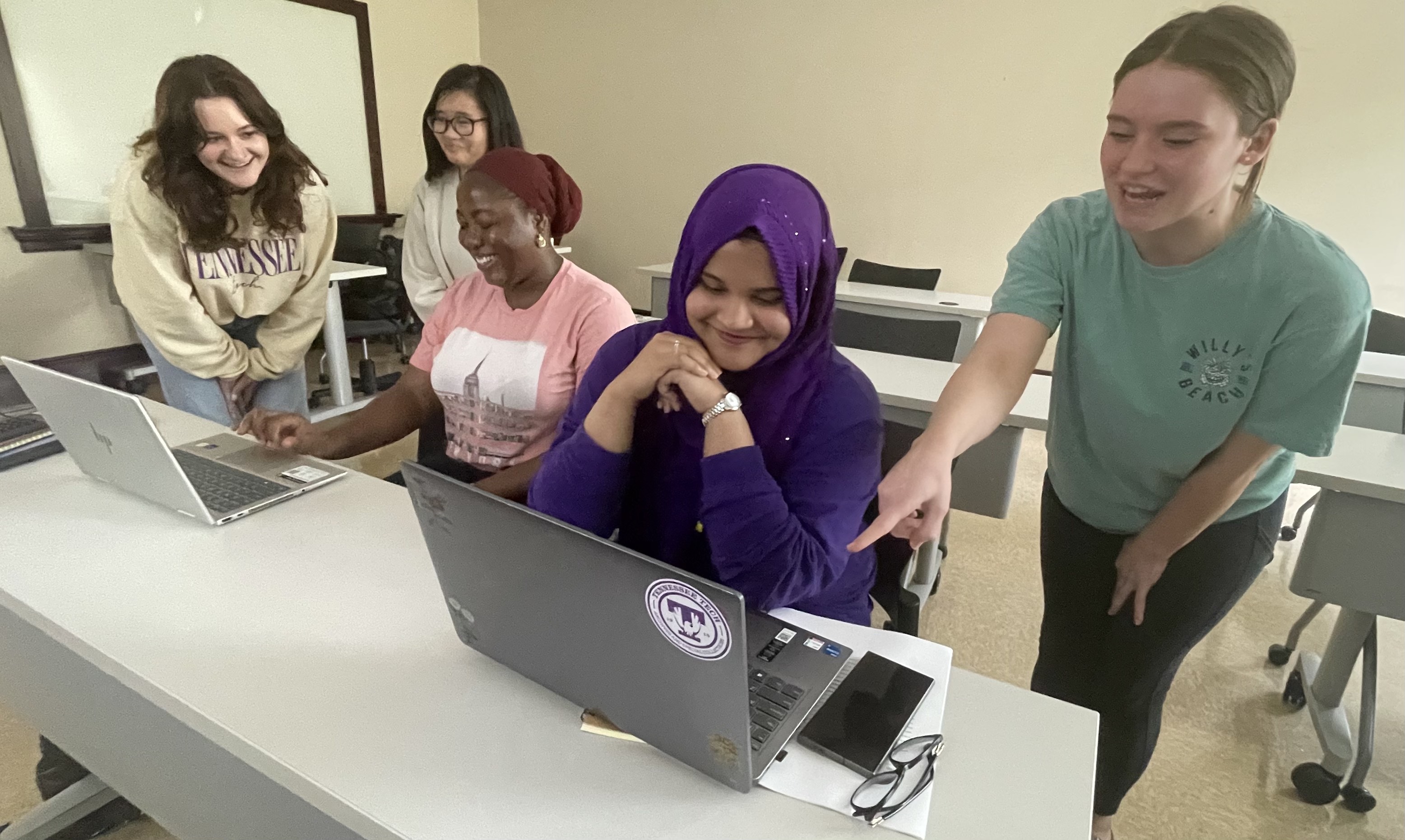
Tennessee Tech students, from left, Katie Barns, Grace Grubbs, Nimotallahi Azeez,
Amina Begum and Sydney Askins collaborate on a chapter they’re collectively writing
for an academic book about artificial intelligence and technical communication to
be published in 2026.
A group of students at Tennessee Tech University is contributing their learning about
the intersection of technical communication and artificial intelligence (AI) to a
chapter in a forthcoming academic book that examines the emerging technology.
"Technical Communication and AI" is taught by Associate Professor of English Mari
Ramler. Her students’ work over the spring 2025 semester will appear as a chapter
in the book AI in Technical Communication: Emerging Technologies and Pedagogies, which is being compiled and published by Routledge Press.
“There are many opinions within the academic community, both positive and negative,
about the influence of AI, but the potential for AI to transform how we teach and
learn is immense,” Ramler said. “This class is designed to provide students with hands-on
experience in navigating AI’s capabilities while developing an understanding of how
it can be used responsibly and ethically in technical communication.”
Composed of six students, both undergraduate and graduate, from diverse backgrounds
and made up entirely of women, the course offers a unique opportunity to engage with
the emerging technology in a hands-on, critical way.
They’ve tested the current technology’s capacity and found it to be useful for tracking
resources, assisting with research, proofreading and editing rough drafts objectively
– but it’s not an excellent generator of content, because its purely logical processing
often dulls the liveliness provided by the human voice.
Finally, they’ve used it to create images, artwork and graphs based on provided information.
Ramler said the course serves as a model for integrating new technologies into higher
education and specifically into technical communication. In other semesters, the course
has explored how different technologies – such as videogame development – impact and
influence technical communication.
“It was time we explored AI in this course,” Ramler said. “One of my goals is to provide
students with real-world experiences that prepare them to address the challenges and
opportunities of integrating emerging technologies into their future careers, so being
able to contribute a chapter to this book is the perfect project. It’s a way for our
experience and learning from this semester to continue beyond the classroom and reach
even more people."
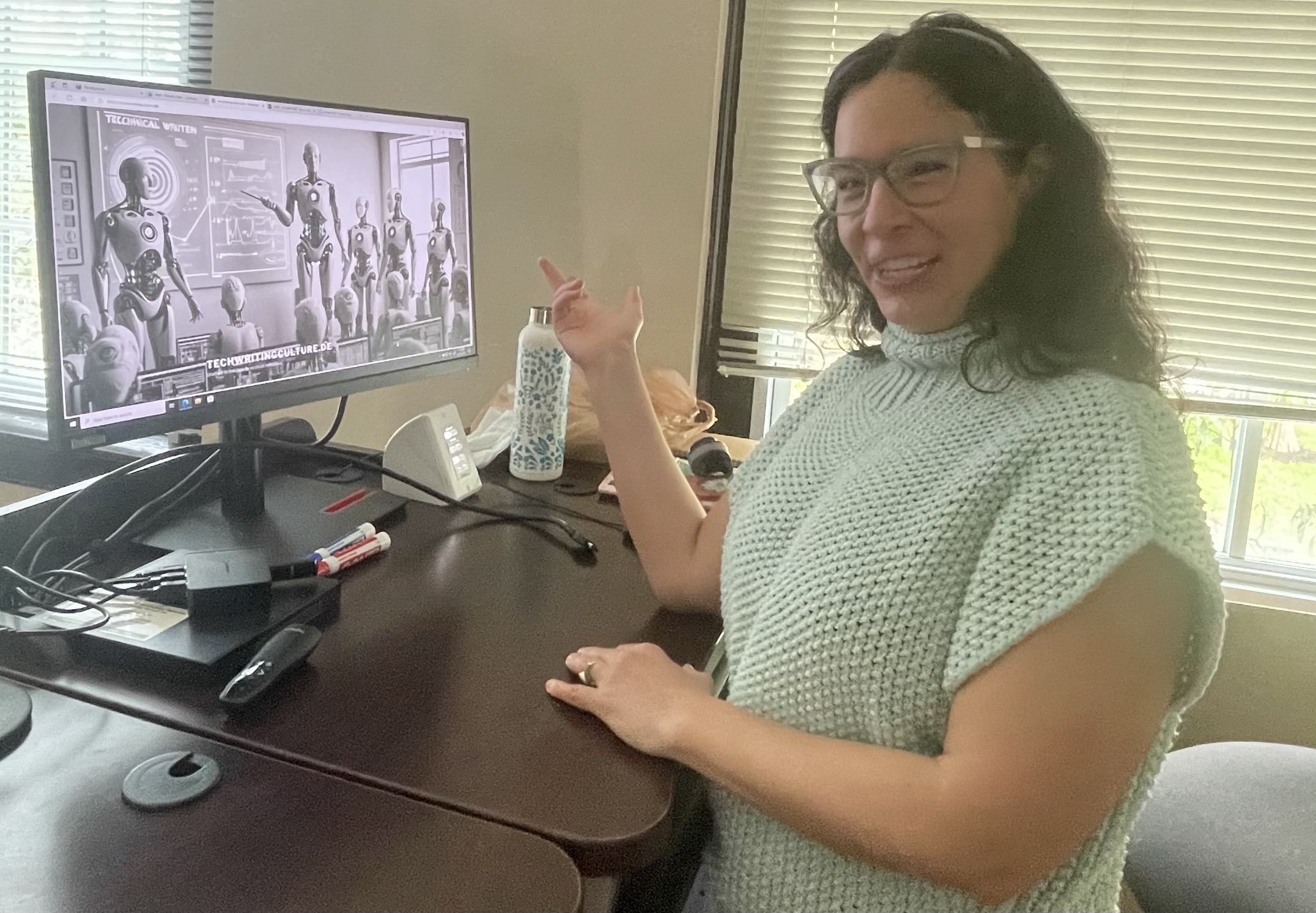
Associate Professor Mari Ramler stands before a screen exemplifying the teaching in
her Technical Communication and Artificial Intelligence course this semester as she
chats with students writing a chapter for a coming book about their experiences using
AI in the course.
The students have worked collaboratively to create different sections of the chapter that examine the practical applications, ethical considerations and potential impact of AI on teaching, learning, communication and all types of work.
“As our world becomes more digitized, it’s important that we engage with these technologies thoughtfully and ethically to ensure they enhance our ability to connect with others,” said Katie Barnes, an undergraduate student in the class from McMinnville.
Sydney Askins, a student from Dickson, agreed. “Tools like chatbots and content creation
software are already becoming integral in some fields. In this class, we’ve explored
how these tools can streamline processes while considering the ethical implications
of automation in the workplace,” she said.
Grace Grubbs, a student from Knoxville, pointed out that instructors and institutions
who ignore or refuse to explore such implications are likely perpetuating the setbacks
they believe adopting the technology would bring.
“We’re marginalized if we don’t learn to properly use it. Refusing to explore it academically removes us entirely from the conversation about its development, which then would put us at a disadvantage in the job market,” she said.
Graduate students Nimotallahi Azeez, from Osun, Nigeria, and Amina Begum, from Sylhet, Bangladesh, say they’ve already seen how the ethical use of AI in the classroom benefits their own educations, helping to put them on an equitable footing with their American peers.
“As a non-native English speaker who aspires to teach English and literature, I may not have the same depth of knowledge about some topics as native English speakers, but AI is a tool that I can use to lead me to resources that give me a deeper understanding,” Begum said.
“Critical thinking won’t go away with AI, but AI can help to homogenize the learning process for all students,” Azeez said.
In addition to exploring the benefits of the technology, the course also explores the issues of bias, privacy and ethics. “The ethical considerations of AI are crucial aspects of this work,” Ramler said.
Overall, the class is a testament to the power of integrating emerging technologies into the classroom in meaningful ways.
“It’s not just about learning to use AI; it’s about understanding how it fits into
the future of technical communication and how it can be used to shape the way we work,
communicate and teach,” Ramler concluded.
AI in Technical Communication: Emerging Technologies and Pedagogies is expected to be published next year.