

Tech graduate students tackle problem of heavy metals in Tennessee greens
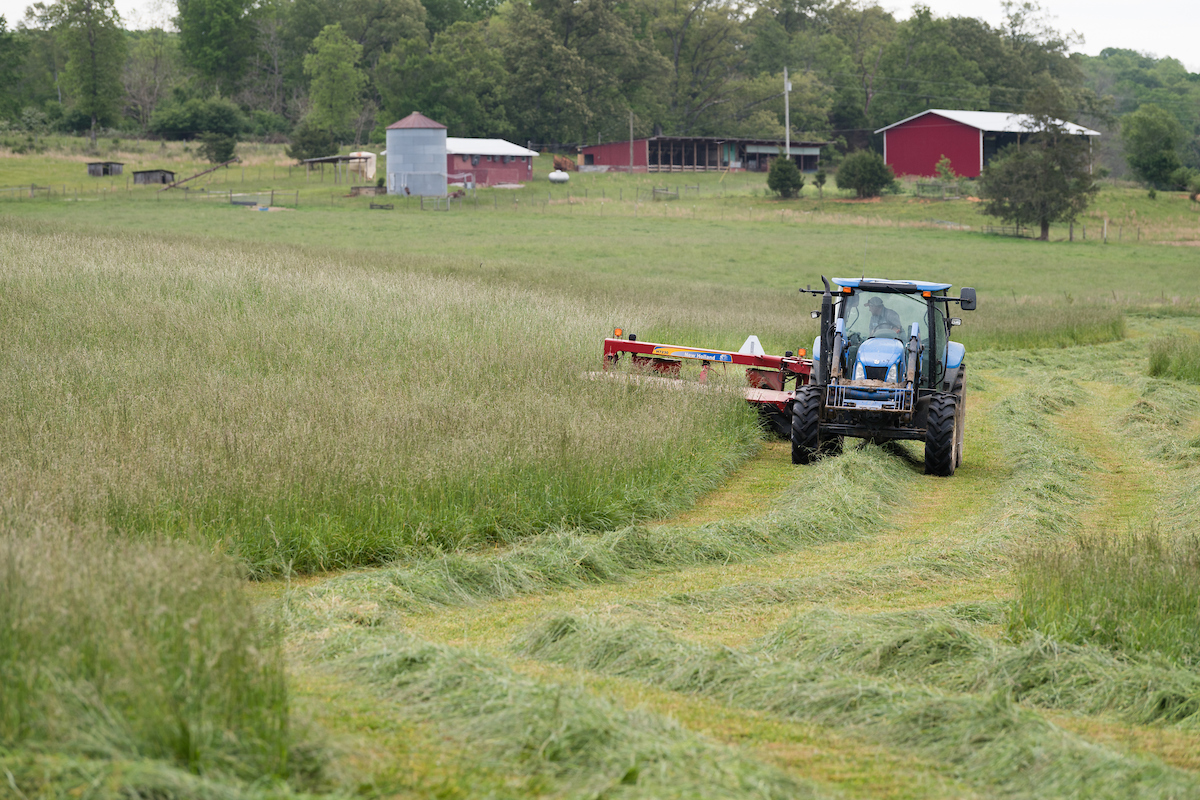
Tech students recently researched pulling heavy metal deposits out of leafy greens.
Three Tennessee Tech University graduate students recently developed a project to
take a closer look at an important issue facing local farms: the presence of heavy
metals like mercury and cadmium in the soil. These toxic metals can be transferred
from the ground into spinach and other leafy greens, posing a health risk to consumers.
“Leafy greens take up heavy metals at higher rates, particularly into the part of
the plant that you eat,” explained Ronnie Dunn, doctoral student in environmental
science. “So, we asked the questions: can heavy metals be reduced in soils? Is it
possible that we could maybe limit the uptake of heavy metals in a plant like spinach?
Or is it possible we can do both?”
He and his fellow students, Shafieh Karami, a doctoral student in chemical engineering,
and Kitty Philips, a doctoral student in environmental science, interviewed three
local farmers to learn more about this challenge.
“All three were in agreement regarding our concerns about the heavy metals and especially
uptake in the vegetables that they're growing,” Philips said.
According to the students’ research on established studies on heavy metals in the
soils in the United States, unsafe levels of mercury and cadmium are not uncommon
in Tennessee.
“The USDA (United States Department of Agriculture) every so often takes food samples
from the market and 93 percent of food samples had cadmium in it. Spinach, in that
same study, was sometimes twice the WHO (World Health Organization) recommended limit,
which is a bit scary,” Dunn said.
“Both cadmium and mercury exposure could cause very severe illnesses like kidney damage,
lung damage, skin irritation, retinal damage and bone damage,” added Karami, “And
also, being exposed to these two metals can raise our chances to develop cancer later
on in life.”
Dunn, Karami and Philips are trainees in a National Research Traineeship program established
at Tech in 2022 from a $3 million grant from the National Science Foundation for the
project entitled “Engendering the Spirit of Gadugi at the Food-Energy-Water Nexus.”
Currently, the program has graduate students enrolled across several doctoral and
master’s degree programs highlighting the interdisciplinary nature of the efforts.
One of the project’s goals is to empower graduate students to identify and work collaboratively
with internal and external partners to solve challenges involving food, energy and/or
water with a particular emphasis in working with those in Appalachian, other rural
and Cherokee communities in Tennessee.
This approach is guided by a strong sense of community-based partnerships and transformation,
says Andrea Arce-Trigatti, faculty in the department of Curriculum and Instruction
and a member of the Renaissance Foundry Research Group at Tech.
To engage with investigating the heavy metals in soils challenge, the student team
used the Renaissance Foundry Model, an effort led by Pedro E. Arce, professor of
chemical engineering at Tech, and his colleagues, J. Robby Sanders and Arce-Trigatti,
which emphasizes innovation-driven efforts guided by critical thinking, leadership
and team-based skills. They also received training in critical thinking and community-based
collaborations from Sabrina Buer, the TTU-NRT program coordinator; Troy Smith, professor
of History; Ada Haynes, professor of sociology and political science; and Rufaro Chitiyo,
associate professor of human ecology.
As part of this process, the student team developed a two-step approach to help alleviate
some of the problem. In their research, they found that the plant called “prince’s
feather” can remove up to two-thirds of these metals from the surrounding soil when
the soil’s pH is low. The solution’s first step would be, during the spring and early
summer, lowering the soil’s pH and planting these prince’s feathers in the spot where
the farmers will later plant leafy greens in late summer and fall, which could potentially
remove a large portion of the contaminants.
Prince’s feather grows best in Tennessee in the spring/early summer, so in the late
summer and fall, farmers could add biochar and lime, soil amendments which make heavy
metals less able to be absorbed by the leafy greens. The student’s model showed this
approach could significantly reduce the levels of heavy metals remaining in the soil
and in turn, the spinach crops.
“Also, if you're really industrious, you can sell the (prince’s feather) flowers to
the floral industry. They're pretty popular,” said Philips.
To make their solution accessible for home gardeners, the team designed a "Safe Spinach"
product prototype: a box containing all the materials needed to implement their remediation
approach in a 4x8 foot garden bed, such as pH tests, organic fertilizers, spinach
seeds and compounds to raise and lower the soil pH. The box and packaging would be
made from compostable materials as well. They estimated that the box could cost around
$60 from a commercial retailer and would produce around 16 pounds of spinach on one
cutting, as well as the flowers.
“That’s $3.73 a pound, whereas [a major retailer's] organic spinach is $9.54 a pound
and that might have some heavy metals in it,” Dunn said.
The student team presented their work to a community-led group of judges at the end
of the semester and followed up with their community partners as part of the course’s
learning outcomes.
“This is important feedback from experts and community partners that calibrates the
student team’s efforts,” said Arce.
“The TTU-NRT program guides students through core and elective courses and a host
of other experiential activities, progressively pursued, to facilitate the acquisition
of knowledge relevant to the three key components of the program, i.e., community-centered
problem identification and solution development (centered on the Foundry), critical
thinking skills (centered on the Critical thinking Assessment Test, CAT) and community
relevant communication skills (centered on the three key partnering communities: Cherokee,
Appalachian and other rural populations including Hispanic/Latino, African American
and others),” said Sanders.