
Tennessee Tech MInDS center prepares students for careers in the AI era
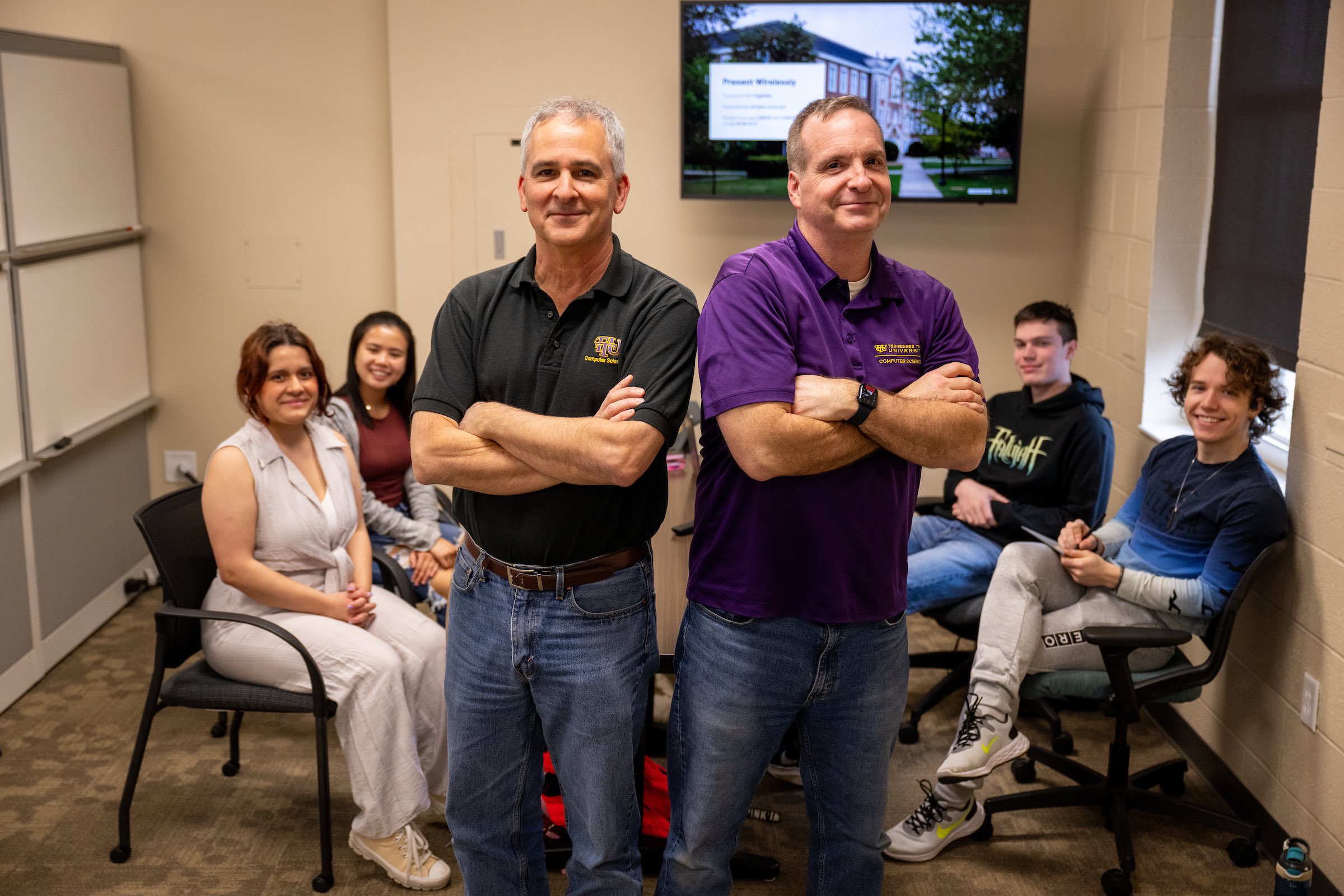
From left: Tech students Jamie Boyd and Kashaina Nucum, members of MInDS AI corps,
Dr. Doug Talbert and Dr. William Eberle, MInDS co-directors, and Tech students Jared
Scott and Ethan Owens, also members of MInDS AI corps.
When computer sciences professors William Eberle and Doug Talbert teamed up as co-directors
of a new center at Tennessee Tech University, you could say it was a meeting of the
MInDS.
MInDS stands for Machine Intelligence and Data Science, and the center addresses a
national focus on the need for education and workforce development in emerging AI
technologies. The concept for such a center is still in its infancy on most college
campuses, so Eberle and Talbert say they hope MInDS serves as a model to others.
Its mission is to work both within and outside the university to foster knowledge
and workforce development in AI through education, research and service, with the
intention of driving innovation and empowering faculty and students to thrive in developing
and using this emerging technology.
“Every major is being exposed to AI in one way or another already,” Eberle said.
Talbert agreed, saying, “AI is going to revolutionize the workplace the way the internet
did about 30 years ago.”
AI is a tool that can assist with writing music, creating graphic designs, looking
up research sources, interpreting large quantities of data and more – but academic
departments have been functioning mostly autonomously in their implementation of AI
technology.
“We can be a lot more effective if we coordinate our efforts. Up until now, sometimes
departments have worked together, sometimes they haven’t. The center will help us
better facilitate those campus conversations and opportunities for interdisciplinary
partnership regarding AI,” Talbert said.
MInDS officially launched last semester, but Eberle said the need for an AI center
had been identified for some time.
“The landscape of large-scale educational and research opportunities in AI is evolving
rapidly, so we needed an organization to coordinate resources and responses,” he said.
It coalesced with the statewide AI TENNessee Initiative, based at the University of
Tennessee in Knoxville and directed by Tech alumnus Lynne Parker, whose previous roles
included founding director of the National Artificial Intelligence Initiative Office
in Washington, D.C., and deputy chief technology officer for the United States in
the White House Office of Science and Technology Policy.
In conversations with Parker, Eberle and Talbert said they realized the MInDS center
could operate similarly to the university’s Cybersecurity Education, Research and
Outreach Center (CEROC), a well-established cybersecurity center at Tech.
For instance, one characteristic of CEROC is the CyberCorps service scholarship program
through the National Science Foundation, which enables selected computer science students
to serve as cyber ambassadors for the university. MInDS is piloting a similar workforce
development scholarship program, AICorps.
“AICorps isn’t a boilerplate replica of CyberCorps, but we were able to take the lessons
we’ve learned from the creation and implementation of CyberCorps and model AICorps
after it,” Eberle said.
The advisory board for MInDS includes four alumni and three non-Tech graduates representing
academic, government and industry sectors. “With guidance from the advisory board,
we can determine what skills students will need to be workforce-ready when they graduate
and how we can help them to accomplish that,” Talbert said.
Both MInDS and CEROC are part of the College of Engineering, and the newly unveiled
MInDS center is currently housed on campus in the Angelo and Jennette Volpe Library.
Students and directors of the new center already plan to have a significant presence
at the Florida Artificial Intelligence Research Society conference coming up in May
2024. About 20 Tech representatives are planning to attend the conference in various
capacities.
“It’s the second oldest conference in the country dedicated to artificial intelligence
research,” Eberle explained. “FLAIRS has been hosting an annual conference for 37
years, and it’s a great event for introducing students to AI research.”
Thirty-seven years may seem like a long time to host a conference for a technology
that seems to have just found a place in the public consciousness with the advent
of ChatGPT and other programs that use AI to assist with basic tasks. However, the
concept of artificial intelligence has existed since ancient Greek mythology.
“In the 1930s, scientists first began asking, ‘Could a machine think?’ And in the
1950s, scientists started actively trying to create machines that could use artificial
intelligence, so it didn’t happen as quickly as it may have seemed to the public,”
Talbert said.
How have they used AI recently?
“We used ChatGPT to give us ideas for center names, and MInDS came out of that session.
So, AI created the name for its own center,” Eberle said.