

Tech physics grad earns prestigious National Science Foundation research fellowship
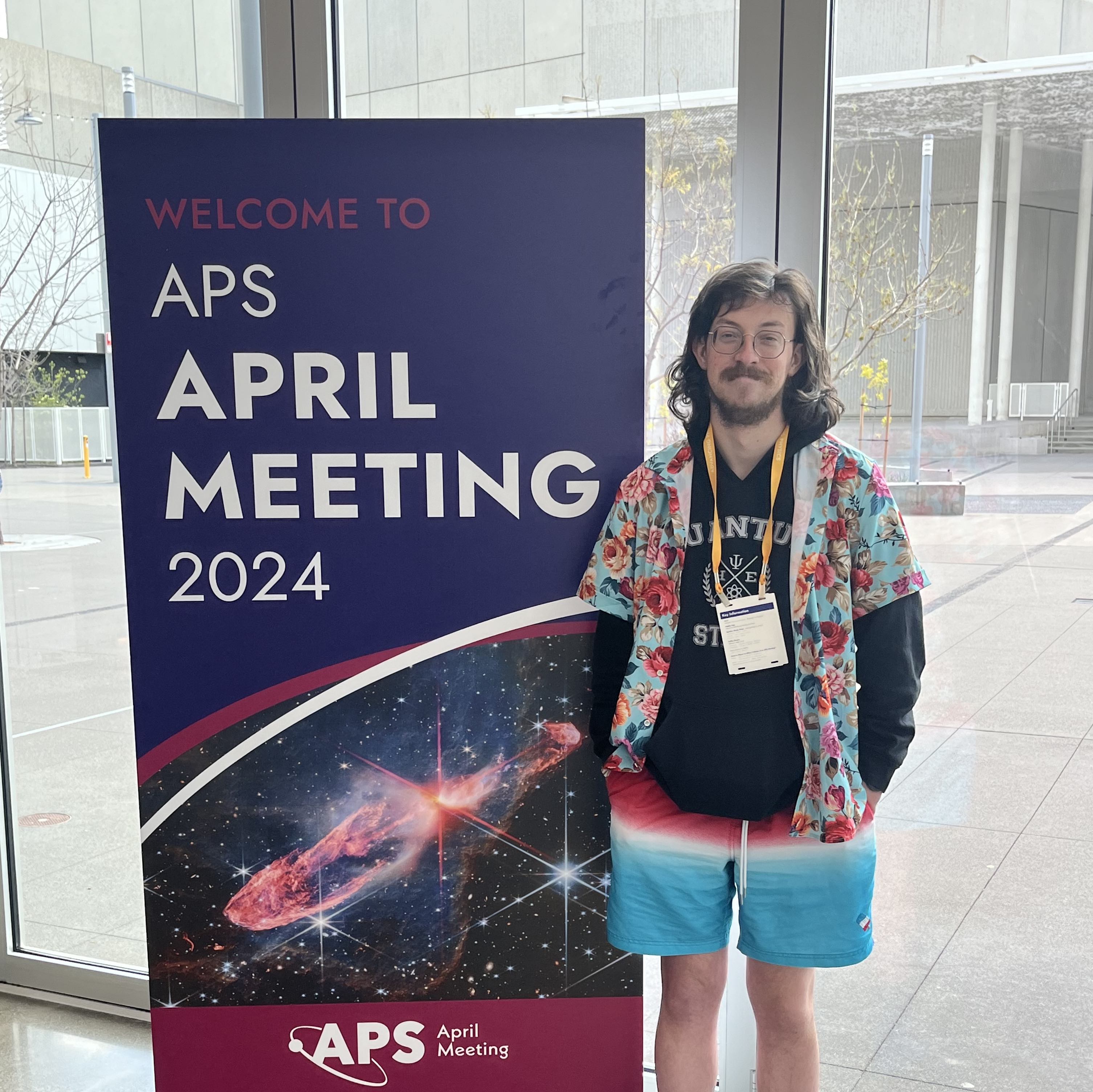
Tech alumnus and National Science Foundation Graduate Research Fellow Luke Parsons
is pictured at the American Physical Society’s April 2024 meeting in Sacramento, Calif.
Photo credit: Joel Watson.
A 2024 graduate of the Department of Physics at Tennessee Tech University is the latest
inductee into the National Science Foundation’s Graduate Research Fellowship Program.
Luke Parsons, a Nashville native, won the prestigious fellowship this past spring
while still a Tech senior. He estimates that less than half of NSF graduate research
fellows earn the title before becoming active graduate students.
“It’s a fellowship for which anyone who is in their first or second year of graduate
school or is intending to start graduate school the upcoming fall, can apply,” explains
Parsons. “If awarded, you become a fellow for five years, during which you can take
three years of funding which pays your stipend and covers tuition.”
The elite program began funding fellowships in 1952 to help strengthen the workforce
in STEM disciplines. Only about 2,000 fellowships are awarded each year from a pool
that typically includes more than 13,000 applicants.
As an NSF graduate research fellow, Parsons is in good company. Forty-two fellows
have gone on to become Nobel laureates, and more than 450 have become members of the
National Academy of Sciences. Other notable recipients of the fellowship include Google
co-founder Sergey Brin and former U.S. Secretary of Energy Steven Chu.
In Parsons’ case, the fellowship will support his highly technical research to better
understand physics phenomena known as neutrinoless double beta decay (0νββ) and coherent
elastic neutrino-nucleus scattering (CEvNS) as a graduate student in North Carolina.
Parsons explains that 0νββ is a theoretical process that has never been observed due
to its rarity but, if detected, could hold answers to unsolved questions in physics
and “lead to a lot of new information and questions about the fundamental nature of
reality.”
Likewise, Oak Ridge National Laboratory explains that ongoing CEvNS research can help
scientists better understand processes involving supernovae, or exploding stars, and
can help inform experiments involving dark matter – invisible matter that is undetectable
by conventional sensors and detectors.
Parsons said the support of Tech faculty and the university’s ample opportunities
for hands-on research at the undergraduate level helped prepare him for success in
his graduate research pursuits today.
“One of the big things that this department loves to emphasize is the accessibility
of undergraduate research,” said Parsons. “They’ve got a lot of research opportunities
and they’re always trying to emphasize those to incoming students.”
Parsons started at Tech in 2019 and, like many, recalls that his academic and personal
life was thrown off-kilter at times during the COVID-19 pandemic, but says the “non-judgmental
pushing and encouragement” of faculty in the Department of Physics helped him continue
towards his goals.
“I definitely don’t think I would have been able to succeed in the way that I have
if I had been at another institution,” he added.
Parsons’ biggest mentor at Tech was Professor of Physics Mary Kidd – the professor
with whom he took six classes, conducted four years of research and served as a teacher’s
assistant.
“She knew I wanted to be a professor one day, so she looked for those opportunities
to give me,” Parsons added.
In between research projects, Parsons also hopes to leverage his NSF graduate research
fellowship in service to a broader mission: improving public understanding of physics
concepts.
“I’m really interested in helping people understand physics better,” said Parsons.
“Because I have this external funding, it gives me more flexibility in what I’m doing
and provides opportunities to improve public understanding of these complicated physics
concepts.”
Thanks to the strong foundation that Tech provided, Parsons concluded, he has a roadmap
to begin that process.
Learn more about the NSF Graduate Research Fellowship Program at www.nsfgrfp.org.