

Tennessee Tech students map out state's death penalty case history in latest project
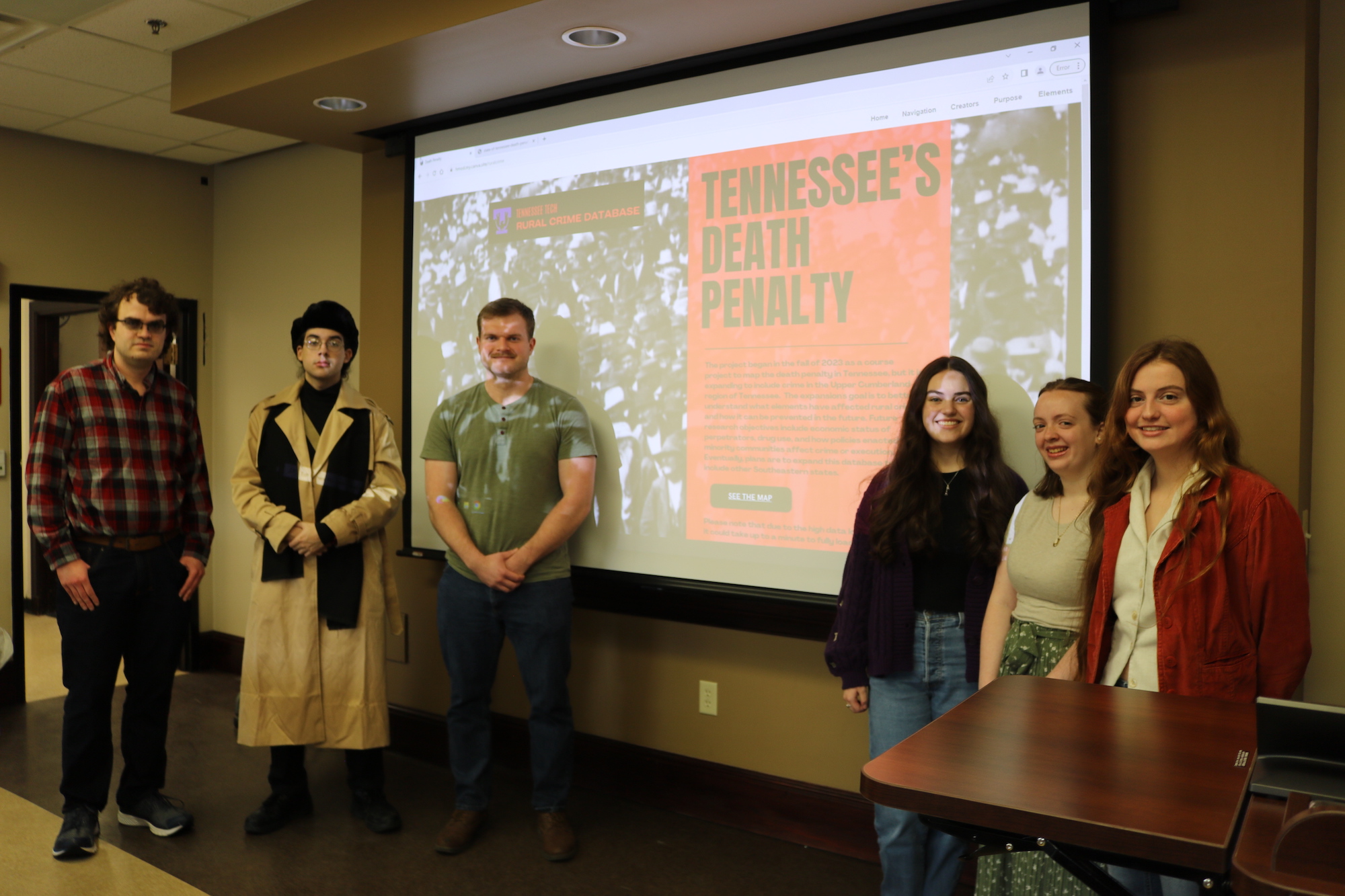
Tech students who created the historic database are, from left, Samuel Harmann, Sebastian
Mocza, Evan Ward, Maggie Knisley, Olivia Howell and April Riley.
Six Tennessee Tech students have created a database that displays their research on
historical records of death penalty cases in Tennessee and, with future work, will
provide a bird’s eye view of underlying social issues that may have contributed to
the crimes.
The tool came about from a project in an intro class for the university’s new digital
humanities minor, a venture birthed across several departments at Tech, including
foreign languages, geology, computer science and history, as well as the Volpe Library.
This new minor option gives students knowledge in a wide variety of subjects, from
data science and statistics to cartography and ethics.
“Digital humanities is, essentially, using computers and digital approaches as a methodology
to examine various humanities fields,” explained Troy Smith, associate professor of
history at Tech, and the project’s supervisor. “Digital Humanities represents the
technological cutting edge of 21st-century humanities research, and a minor in it
greatly enhances students' desirability to employers and grad programs.”
Students working on the project included Samuel Harmann, computer science major, of
Atlanta, Ga.; Olivia Howell, history major, of Manchester, Tenn.; Maggie Kinsley,
history/political science major, of Hendersonville, Tenn.; Sabastian Mocza, fine arts
major, of Spencer, Tenn.; April Riley, history major, of Beechgrove, Tenn.; and Evan
Ward, computer science major, of Gallatin, Tenn.
This past semester, the students dug into research on death penalty cases in Tennessee’s
history and organized them by the county where the crime was committed. All this they
turned into an online map that displays the number of cases per county and details about each individual case,
including any available news references.
“One of the things we discovered from this project is just how little information
was publicly available,” said Mocza. “The resources we found are even less complete
than what we've created. So, our tool is able to provide information that was either
almost impossible to find or extremely obscure.”
Some of the early cases they unearthed involved the death penalty for crimes such
as horse theft, rape, murder and sedition, with hanging as the principal method of
execution. These days, the death penalty is reserved for first-degree murder convictions,
though in 2023 Governor Bill Lee put a hold on this form of punishment until a review
of the legal practices and protocols can be performed.
“There is no other project quite like this out there that we have seen, and certainly
not in Tennessee – and certainly not from a rural standpoint,” Howell said.
A recent Rural Reimagined Faculty Grant from the university has funneled $17,000 toward
this project to enable to students to take their research even further. They next
plan to look at rural crimes in general – not only ones that got the death penalty
– and overlay that with information on different socioeconomic factors such as unemployment
and poverty rates to see what connections there may be.
“If one only looked at the crime statistics, it would reveal what crimes were being
committed – but only by expanding into the socio-economic statistics can anyone figure
out why, and what to do to prevent it,” Smith said.
In addition to creating a valuable resource for others, the students also increased
their skill level in areas such as finding and collecting historical data, database
creation and critical thinking. It also widened their horizons to discover more possible
career options once they graduate.
“It’s been great to be able to work on something that I could see doing as a career,”
Riley said. “That’s not something I thought I’d get to do as an undergrad.”
In addition to Smith, other Tech faculty and staff will be aiding the students in
their research including Megan Atkinson, archivist; Paula Hinton, associate professor
of history; and Lauren Wright, assistant professor of sociology and political science.
“Over time, I see this project as having the potential to become a repository of information
about crime in rural counties throughout Tennessee and the rest of the country, and
thus a tool that could be used by researchers everywhere to get at the data from many
different angles: history, sociology, criminology, economics, law enforcement, various
nonprofits... it could become quite important,” Smith said. “There has been a lot
of research about urban crime, but surprisingly little about the unique circumstances
of rural crime.”