

Tennessee Tech research featured in new waterfowl exhibit
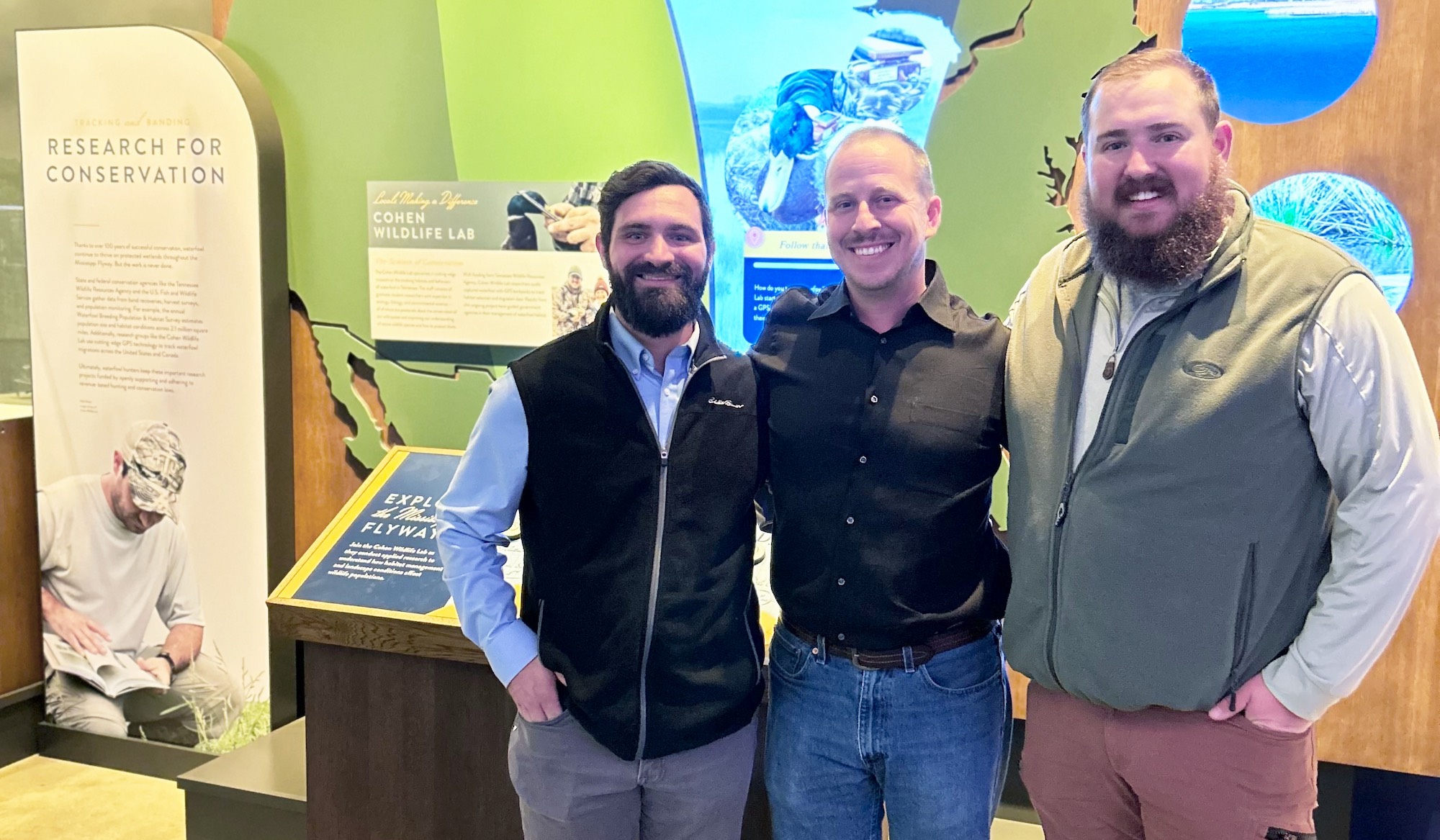
Visiting the waterfowl exhibit at the Discovery Park of America are, from left, Nick
Masto, Ph.D. student; Brad Cohen, associate professor of wildlife ecology at Tech;
and Cory Highway, Ph.D. student.
Research conducted by Tennessee Tech University wildlife ecology students and faculty
is front and center at the new waterfowl exhibit at Discovery Park of America in Union
City. The exhibit, titled “Duck, Duck, Goose: Waterfowl of the Mississippi Flyway”
highlights the importance of Tennessee and other southeastern states to wintering
waterfowl, the science behind waterfowl management and the partnerships between regulatory
agencies, researchers and hunters to facilitate conservation.
Brad Cohen, associate professor of wildlife ecology at Tennessee Tech, and his students
have been tracking waterfowl in a variety of ways. One common technique used for decades
attaches an aluminum band around the duck’s leg and requests hunters who harvest the
birds to report the harvest date and location. The more high-tech technique involves
deploying newly developed GPS transmitters that ducks wear like backpacks and can
monitor a bird’s exact location 24 hours a day. Both old and new technology can be
used to better understand waterfowl ecology and management.
“Our research shows just how far some of these ducks travel every year," Cohen explained.
"We've tracked ducks that wound up flying over 7,000 miles only to come back to the
exact same spot the next winter. They could go anywhere they wanted, but they keep
coming back to the exact same spot. My students and I try to understand why something
like that occurs.”
Discovery Park of America reached out after hearing about the study and asked if Cohen
and his students would like to be included in the new permanent display. Now their
work is featured in this first exhibit at the entrance of the museum. Guests can learn
more about waterfowl with interactive touch stations, immersive experiences, maps
and more. The exhibit also features photos of Tech students conducting field research.
The research featured was funded by the Tennessee Wildlife Resources Agency and U.S.
Fish and Wildlife Service, along with contributions from Tech’s Water Center and School
of Environmental Studies.
Along with Cohen, the research was carried out by Tech Ph.D. students Nick Masto of
Greenville, S.C., and Cory Highway of Grand Rapids, Mich., and Abby Blake-Bradshaw
of Havannah, Wis., and master’s student Lydia Holmes of Ames, Iowa. Their fieldwork
capturing, tagging and tracking ducks in West Tennessee forms the basis of the graduate
research they are conducting in Tech's biology program.
"This is probably one of the most gratifying things I’ve ever done in my work,” Cohen
said. “Hundreds of thousands of people every year are going to see our research. Several
of us got to go to the grand opening of the exhibit in November, and to see people
coming through, interacting with the display, and learning about what we do and why
was really rewarding.”
Discovery Park of America is located at 830 Everitt Blvd. in Union City, TN, and includes
a museum and heritage park. For current open hours and ticket prices, visit www.discoveryparkofamerica.com.