

Tennessee Tech’s ASCEND Center launches GENESIS to expand AI research, economic growth

Tennessee Tech University is expanding its role in advanced computing and scientific discovery with the launch of GENESIS, a high-performance computing (HPC) cluster designed to accelerate large-scale research applications, strengthen workforce development and support technology-driven economic growth across Tennessee.
GENESIS will be Tennessee Tech’s largest scientific instrument across its research infrastructure and will strengthen the university’s capacity for discovery across disciplines. The system was commissioned by the university’s ASCEND Center (Advanced Scalable Computing, Extreme Networks & Data), its flagship center for high-performance computing, AI infrastructure and advanced networking research.
Built on 27 advanced server nodes powered by 108 AMD InstinctTM MI300A accelerated processing units, GENESIS can perform more than 13 quadrillion calculations per second. The system will support research across multiple disciplines, including engineering simulation, AI and large-scale machine learning, cybersecurity and AI threat analysis, environmental modeling, smart manufacturing, data analytics and visualization, materials science and more.
University leaders say GENESIS positions Tennessee Tech to compete more aggressively for federal research funding, continue to forge partnerships that translate research into economic growth and prepare students for careers in Tennessee’s rapidly expanding AI and advanced computing sectors.
“In the AI era, research universities that build world-class computing capacity will help define the future of innovation,” said John Liu, interim provost and vice president for academic affairs at Tech. “GENESIS represents a strategic investment in Tennessee Tech’s future, attracting top faculty and students and research funding that will elevate Tennessee Tech’s national research profile—while also creating new opportunities for Tennessee students to develop advanced skills and pursue high-impact careers in AI and emerging technologies.”
The ASCEND Center was established to advance Tennessee Tech’s research capabilities in high-performance computing, AI infrastructure and extreme-scale networking. The center supports workforce development, industry collaboration and national research partnerships while positioning Tennessee Tech as a leader in advanced computing infrastructure.
“High-performance computing makes AI possible,” said Anthony Skjellum, ASCEND Center director and professor of computer science. “GENESIS offers our researchers the ability to work directly with a world-class compute system that equips them to win major federal grants, attract outstanding doctoral students and become go-to partners for national laboratories and industry leaders.”
High-performance computing systems like GENESIS enable researchers to process and analyze enormous amounts of data at speeds far beyond conventional computing systems. The system’s unified-memory architecture and high-bandwidth design are intended to support increasingly complex AI and simulation workloads while reducing many of the limitations associated with other available computing systems.
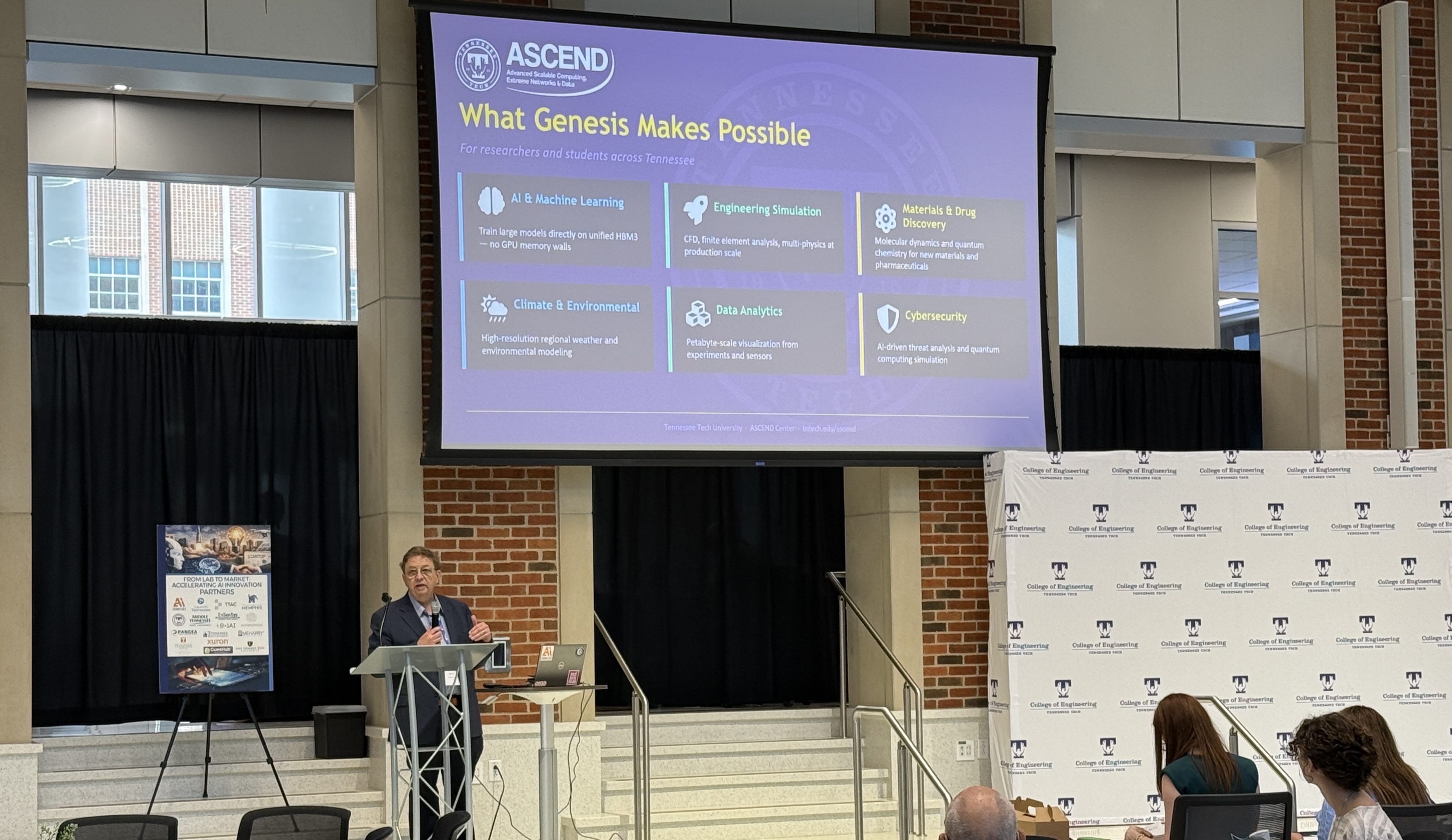
GENESIS will be housed at Tennessee Tech’s Crossville Research Center, which university leaders envision as the foundation for a future high-technology research park serving the Upper Cumberland and Middle Tennessee regions.
“By anchoring the Crossville Research Center with world-class computing infrastructure, Tech is creating a collaborative campus where university researchers, technology companies, federal agency partners and startups work side by side on the frontier problems of AI, computing, cybersecurity and data science,” said Terry Saltsman, Tech’s chief government affairs officer and director of Crossville Research Center.
While the technical specifications of GENESIS are significant, university officials emphasize the broader impact of the cluster and its location at the Crossville Research Center on economic development for the Upper Cumberland region and the state.
“As Tennessee’s economy becomes increasingly driven by artificial intelligence, advanced manufacturing, cybersecurity and data-intensive technologies, university research infrastructure like GENESIS plays an important role in developing workforce talent, research capacity and innovation ecosystem needed to compete nationally for high-tech investment and high-wage jobs,” said Michael Aikens, acting vice president for research and economic development and executive director for the Center for Rural Innovation at Tech.
For Tennessee Tech’s College of Engineering, GENESIS bolsters the college’s reputation for producing career-ready graduates.
“Advanced computing and AI are rapidly reshaping engineering, manufacturing, energy, healthcare, national security and nearly every technology-driven industry,” said Joseph C. Slater, dean of the College of Engineering, “This HPC cluster gives our students the opportunity to tackle problems at a national scale and hands-on experience using the same types of advanced computing systems increasingly relied upon by national laboratories, technology companies and federal agencies.”
To learn more about the ASCEND Center at Tennessee Tech, visit www.tntech.edu/ascend.