

Tech doctoral student wins second national award for environmental research
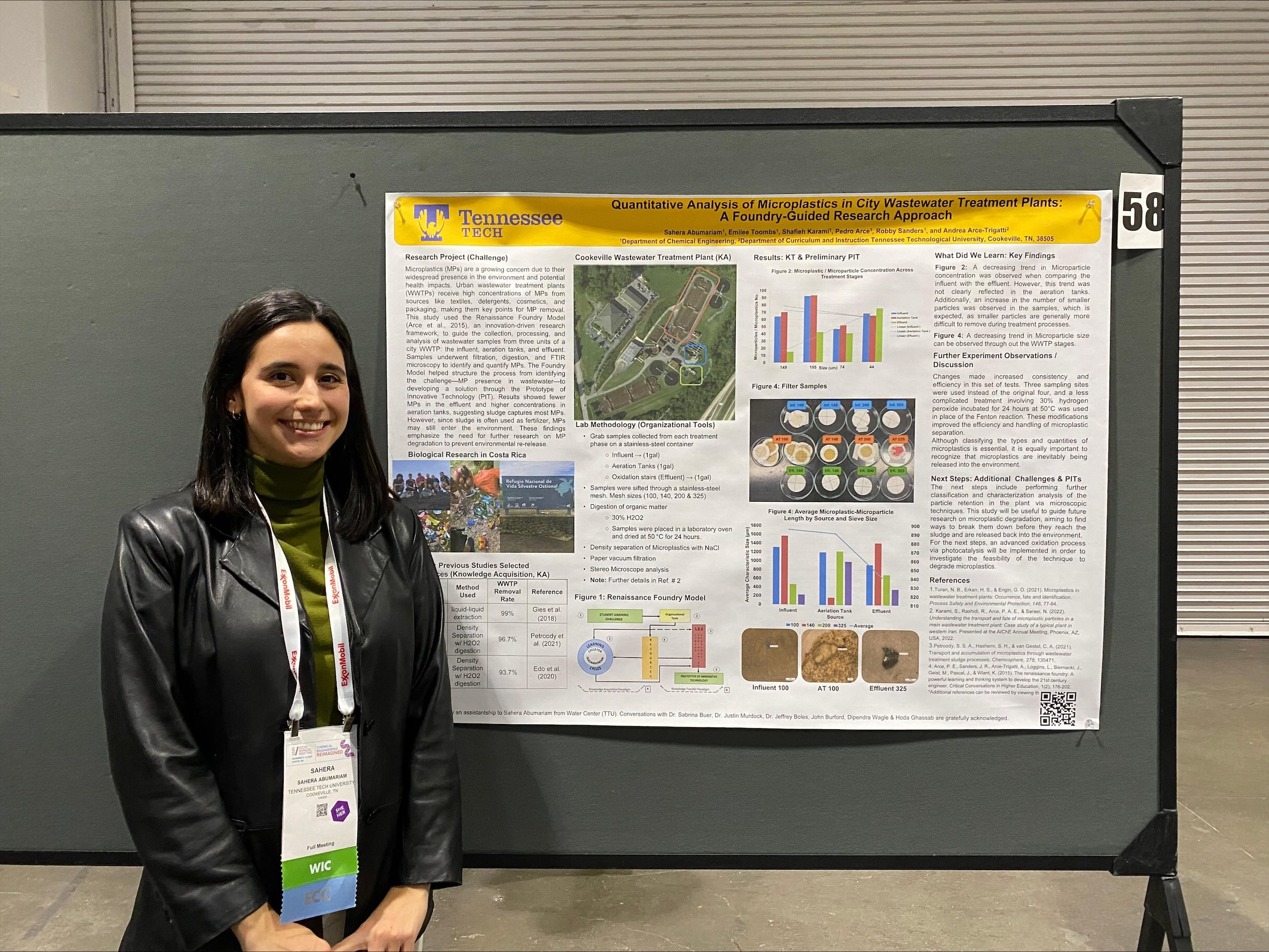
Tennessee Tech University chemical engineering doctoral student Sahera Abumariam has once again earned national recognition for her environmental research, taking first place in the environmental division at the American Institute of Chemical Engineers (AIChE) National Meeting. This marks the second time Abumariam has won the prestigious award in this category for her studies of microplastics in wastewater treatment.
"I felt very honored," Abumariam said. "It's nice to see your work being recognized by our home professional society at its national meeting."
Abumariam's latest research builds on her previous award-winning work examining how microparticles, including plastics, travel through city wastewater treatment plants such as the one in Cookeville. This year, she expanded the project by analyzing microparticles from the samples she gathered, working on identifying what and exactly how much of each type was present. The research focuses on understanding particle retention in wastewater treatment plants, addressing a growing environmental concern as these tiny particles can escape standard filtration systems and pose risks to ecosystems and human health.
A key component of Abumariam's research is her integration of the Renaissance Foundry Model, an interdisciplinary teaching platform developed at Tech.
“The Foundry was used as the guiding research methodology for this project,” Abumariam said. “It is a useful tool to use when you are researching because you can always go back to it and check where you are. The integration of the Foundry into the research is one of the novel aspects of my poster.”
According to Pedro Arce, Ph.D., chemical engineering professor and University Distinguished Faculty Fellow at Tech, Abumariam's co-advisors and her colleagues have been instrumental in preparing Abumariam for success on the national stage. Graduate students in his Environmental Catalysis Research Group are encouraged to present at technical meetings, including Tech's Annual Student Research and Inquiry Meeting.
"Sahera is a very dedicated and talented student who works very hard on advancing her research," Arce said. "She is methodical, very critical of the results and always checks the literature to make sure that their results are consistent with published works."
Abumariam credits her collaborative team for the project's success, including co-advisors Arce; Robby Sanders, Ph.D.; and Andrea Arce-Trigatti, Ph.D. Graduate student mentor Shafieh Karami and undergraduate researcher Emilee Toombs also played important roles in the experimental work.
“We are so proud and excited to see Sahera’s talent and dedication recognized on the national stage,” Arce-Trigatti said. “She brings remarkable resilience, integrity and leadership to everything she does, and this award reflects the strength of her voice and the impact of her work in this field. It’s truly a joy to see her shine, and we can’t wait to continue collaborating with her as she continues to contribute to the field.”
The research aligns with Tech's NSF-NRT grant on the Food, Energy and Water (FEW) nexus topics identified as areas of national interest.
“We believe that her dissertation will open innovative ways to eliminate water contaminants and help to recycle wastewater,” Arce said.
Sanders added, “It is very exciting to witness Sahera ’s excellent work and her highly collaborative, community-focused approach to the development of innovative solutions to complex problems at the FEW nexus. We hope that her national recognition will serve as a catalyst for other students.”
Abumariam is currently finalizing the analysis of microparticle samples to complete this portion of her dissertation. Next, she will continue work on her research on breaking down particles using light-based chemical reactions as she pursues her Ph.D. in engineering with a concentration in chemical engineering.
“The opportunity to share my research in a national meeting with other colleagues and students made me realize the importance of communicating results to a larger audience,” Abumariam said. “I just wanted to say thank you to everyone who has supported and believed in me throughout this process. It feels really nice and supportive to have people like that by your side.”