

Tennessee Tech’s English faculty examine AI’s impact on writing
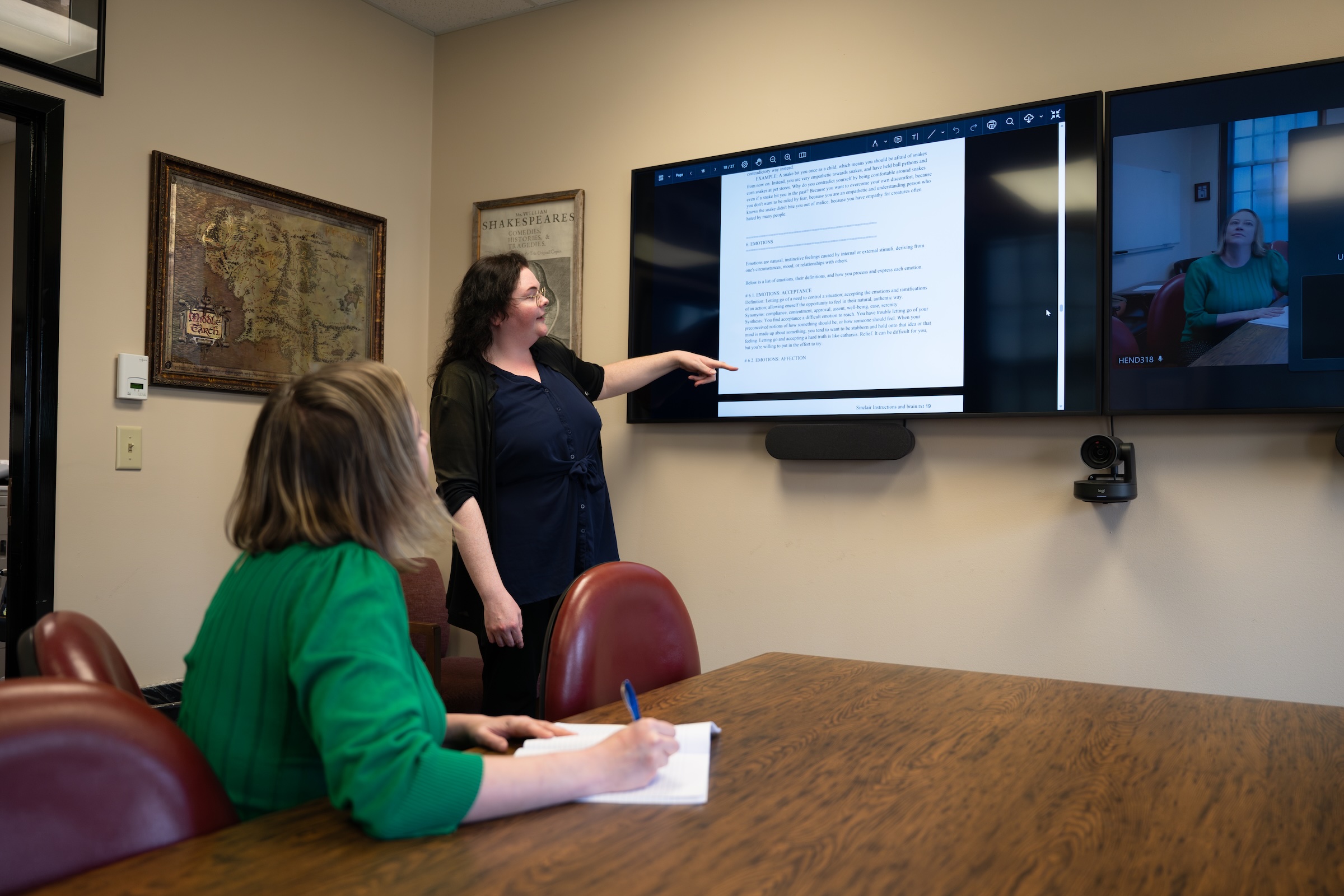
As artificial intelligence transforms how people write, research and communicate worldwide, faculty in the English department at Tennessee Tech University are not avoiding the technology. Instead, they are bringing AI into the classroom and challenging students to examine its implications for writing, language and the role of the human voice.
“I think it is important that we have serious discussions about it,” said Paulina Bounds, professor of linguistics at Tech. “We don’t want to look at it blindly as just something cool you can use; we want students to explore what is really behind it.”
In her composition and linguistics classes, Bounds’ students test the capabilities of AI while learning to analyze and think critically about what it produces. They explore benefits such as tools to support study habits, as well as pitfalls, including environmental concerns, the potential for inaccurate or biased information and questions of authorship.
“By the end of the semester, I consistently see students reach a point where they say, ‘Okay, now I understand how to use AI effectively, but I also understand the boundaries I’m comfortable with,’” Bounds said. “They also think more deeply about their voice and individuality in their writing.”
Mari Ramler, rhetorician and associate professor of English, incorporates experimentation with AI into her professional and technical communication classes. In one assignment, students write a short paper using AI, then investigate the results. They often find the technology invents sources or reflects bias.
“I ask them to consider, ‘What were you better at? What was it better at? What was a wash? What surprised you?’” Ramler said. “They see that this is a tool with faults. It’s something I can’t just tell them — they have to experience it.”
This experimentation has also been eye-opening for graduate students. Whitney Stevens, who is pursuing a master’s degree in English, recently completed a research project examining AI’s capabilities in creative writing.
Concerns about AI replacing human authors inspired Stevens to use her coding hobby to create her own AI writer, which she named Sinclair. She uploaded a 28-page document she wrote to give the AI a fully developed identity, including personality traits, beliefs, a backstory and opinions on topics like love and mortality.
Stevens then asked the program to write a short fiction piece using the same prompt she used. Her story took about four hours; Sinclair’s took roughly 15 seconds. While the AI-generated story was entertaining, Stevens observed a clear difference — one that aligned with her research findings.
“People were given stories to read and asked which they preferred, not knowing one was written by AI,” Stevens said. “The research found they often preferred AI-written stories — but with one caveat. Those stories were typically in genres like sci-fi, fantasy and romance. Readers made a clear distinction between what entertained them and what moved them. AI writing was more entertaining, but it didn’t linger like writing from human authors.”
Erin Hoover, associate professor of English who teaches creative writing with a specialization in poetry, is also examining AI and authorship in her general education literature course. Students study computer-generated text dating back to the 1950s, large language models, and poetry and novels created with AI.
“We’re not saying AI is good, and we’re not saying it’s bad,” Hoover said. “We’re asking, ‘How are authors using it?’ and ‘Where are we at this point in time?’ These texts help us consider both the possibilities and limitations of AI-generated or collaborative work. More often than not, we return to the importance of human intention.”
Students in the course complete a research-based project exploring some aspect of AI and creative work. The assignment encourages them to move beyond surface-level opinions and engage with the technology’s complex and often philosophical questions.
"It's surprising to me that humanities and English as a discipline are thought to be separate from questions about artificial intelligence, because they're, in fact, very central to its development and use," Hoover said. "Computer scientists can't innovate by themselves. Programmers can't do it by themselves. They need the input of experts in various fields."
Ramler agreed. “AI is exciting and terrifying,” she said, “but there are no better instructors to teach a new communication tool than humanities professors — people trained to work with language, conduct cultural critique and explore what it means to be human.”
This fall, Tech’s English department will offer several sections of a digital literacy course that fulfills a new general education requirement, helping ensure all freshmen gain a strong foundation in understanding this rapidly evolving technology.
“We’re going to teach you the tools. We’re going to teach you the critique. And we’re going to teach you not to be afraid,” Ramler said. “The people in humanities are the people who can do this best."