

Tennessee Tech students design, build adaptive playground equipment for local elementary school
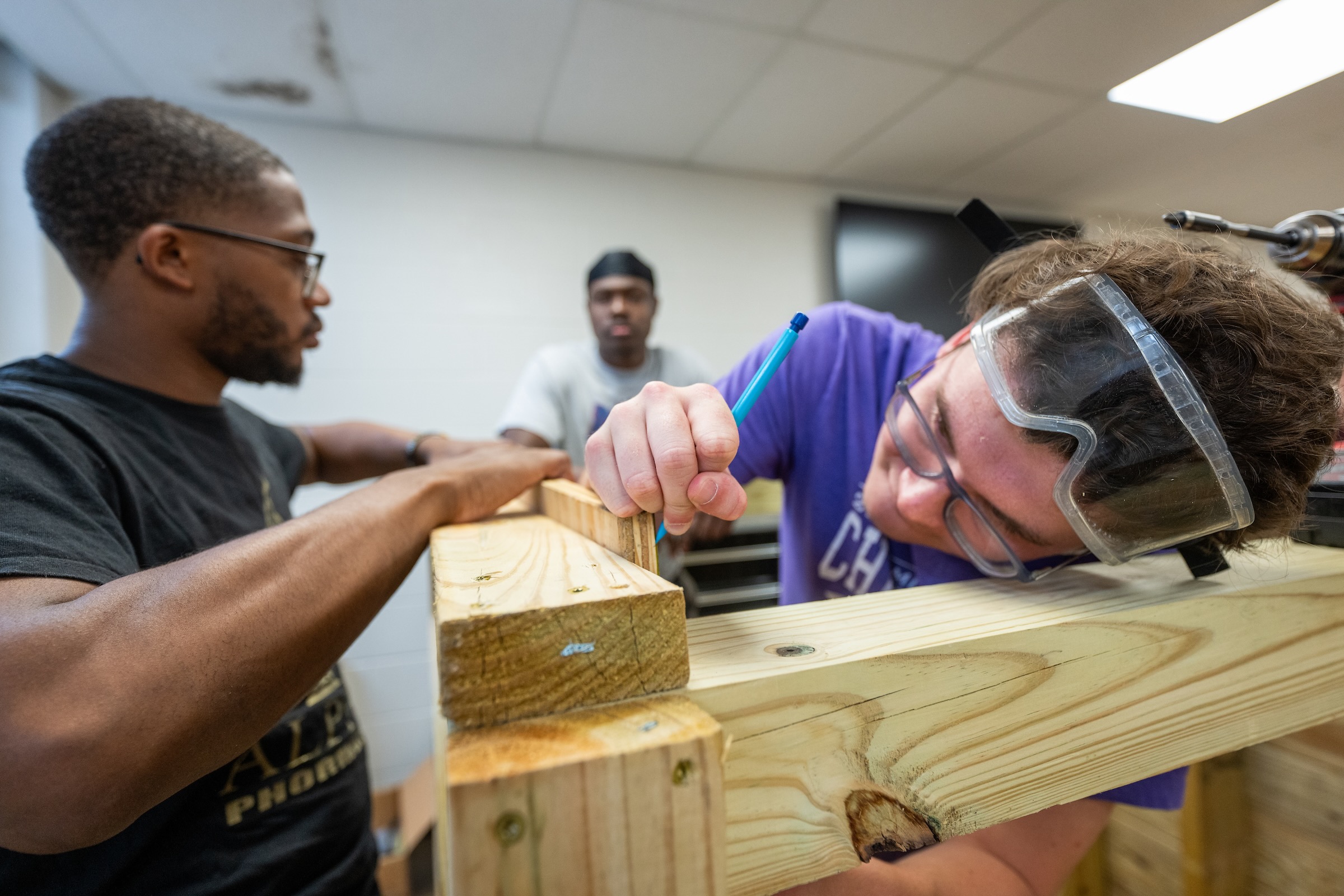
From left: Tennessee Tech students John Craw, Richard Bryant and Ethan Scully build
the adaptive playground equipment that would later be delivered to Findlay Elementary
School in Sparta, Tenn.
What began 25 years ago as a built-in class project has become a benefit to “a neighborhood’s
worth” of Tennessee children with special needs.
In professor Stephen Canfield’s kinematics and dynamics of machinery course at Tennessee
Tech University, students are challenged each semester to turn theory into practice
with the Tech Engineering for Kids initiative, which has produced hundreds of custom-designed devices to meet the special
needs of families in middle Tennessee.
Over the years, the projects have ranged from mobility devices to tailor-made prosthetics.
One project from this year’s effort landed at Findlay Elementary School in Sparta,
where a Tech engineering student team designed and built an adaptive piece of playground
equipment.
The project was inspired by Alivia Mosher, a student with cerebral palsy. Although
it was centered on her needs, it was created with the entire school in mind.
“We don’t have a lot of inclusive playground equipment right now, but it is a priority
for us. We are in the process of getting more,” said Kyle Hicks, assistant principal
at Findlay. “It’s very costly, and while we are doing the best we can with fundraising,
being able to work with Tech has had a huge impact on our school.”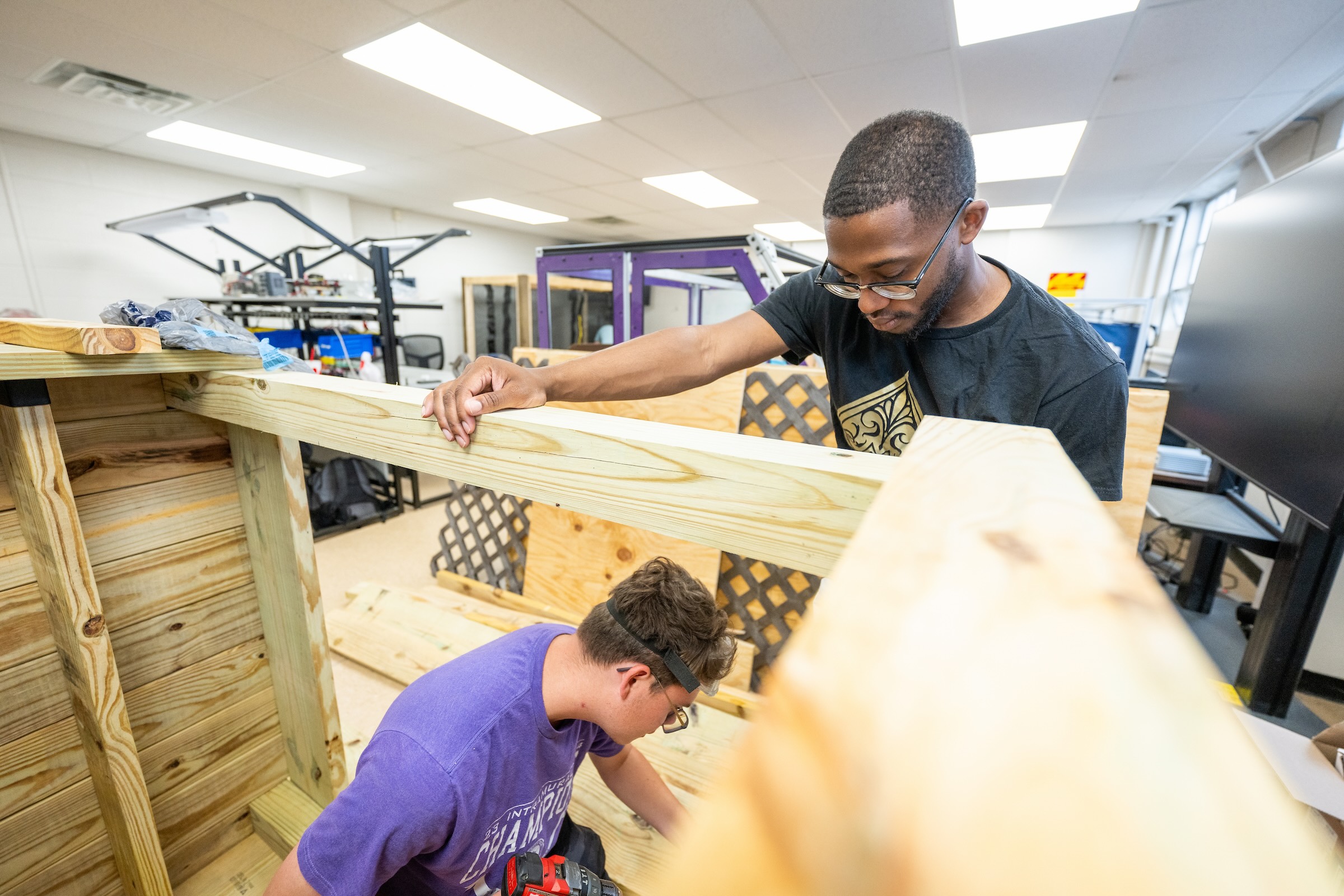
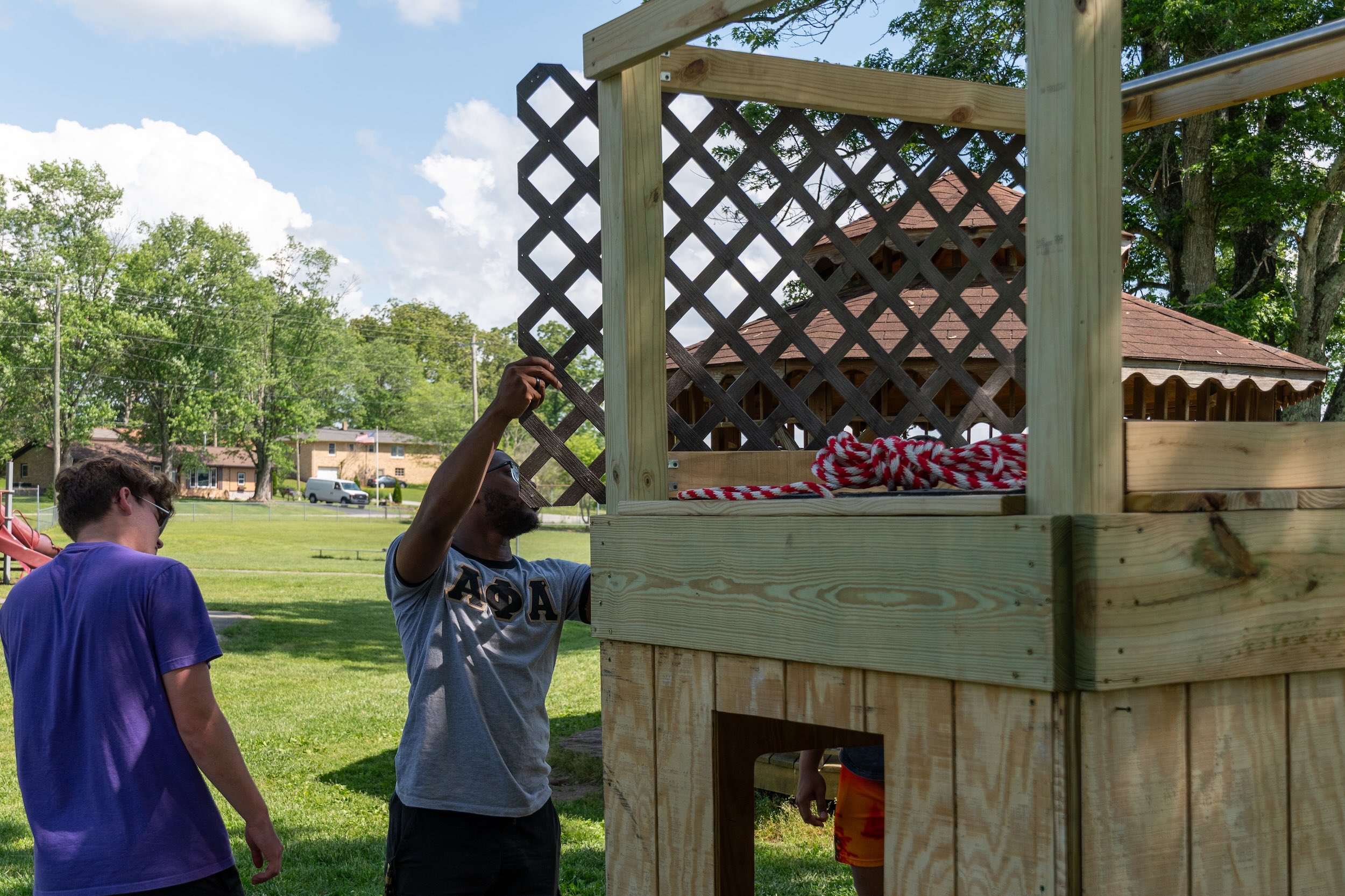
Top photo: Tennessee Tech students John Craw and Ethan Scully are shown putting the finishing
touches on the adaptive playground equipment their group designed and built as part
of the Tech Engineering for Kids project. Bottom photo: Ethan Scully and John Craw install a piece of lattice on the balcony of a playhouse
installed on the playground at Findlay Elementary. The playhouse is made to withstand
weather, hold the weight of children and adults, and accommodate the needs and wants
of a student at the school with cerebral palsy.
The students began by talking with Alivia and her family about what kind of play she
enjoys. One of 14 children, she has several siblings who attend Findlay with her.
The Tech students found that being able to play with her family and friends was important
to her.
They then modeled the structure to resemble a traditional playhouse, ensuring she
could join her peers without feeling set apart.
“We wanted it to look like a regular piece of playground equipment so she could enjoy
it right alongside her friends,” said John Craw, a senior mechanical engineering major
last semester when the project began.
Safety was a guiding principle throughout the design process, the group said. They
not only accounted for the weight of children playing but also for the possibility
that adults may need to intervene.
“We designed it to sustain the weight of two or three adults, in case they needed
to climb on it to help a child. We didn’t want it collapsing on them both,” said Ethan
Scully, a junior mechanical engineering student.
Weathering, stability and accessibility were all factored in too.
Another group of students in the class worked on improving Alivia’s mobility around
the playground itself, adding a removable stabilizing front wheel to her wheelchair
to help her navigate mulch, grass and other uneven terrain.
Those details matter, Hicks said, because Alivia is determined to play no matter what.
“She’s fearless because she’ll go play with her friends on equipment that’s not very
adaptive. This piece gives her a chance to play with her friends and keep her safe
at the same time,” he said.
For the Tech students, the work was both technical and deeply personal.
“It’s easy to think something like this looks simple, but when you’re responsible
for this kind of project, you begin to realize that every detail matters – materials,
measurements, safety, sourcing. A lot of thought goes into it,” said Richard Bryant,
a junior mechanical engineering major.
Craw said the project gave him a clear picture of what it means to be an engineer.
“The most rewarding thing is knowing we’re making a difference in someone else’s life,
because that’s what engineering is about – solving problems and helping people,” he
said.
Bryant agreed, saying it was humbling to work on the project. “We know she’ll enjoy
it as much as the other kids will. It’s pretty great to know we’re going to be a part
of creating something like that.”
Hicks said the partnership with Tech makes a difference with Alivia and beyond. “This
gives Alivia the best opportunity for safe play, and it benefits all our students.
It helps the entire school,” he said.
Canfield, who has guided these projects for more than two decades, said the Findlay
equipment represents the best of service learning: applying classroom knowledge to
real-world needs.
“Each semester, students get the chance to put their knowledge to work in a way that
changes lives,” he said. “The project may seem small, but each one has a tremendous
impact. That’s the kind of engineering we want our students to be doing – problem
solving with purpose.”
For the Findlay students, the new equipment is already making recess more inclusive.
For Tech students, it’s a project that reinforces why they chose engineering in the
first place.
“At the end of the day, we may never see this structure again, but the kids are going
to see it and use it every day. That’s what makes it worthwhile,” Craw said.
Craw, Scully and Bryant were joined on the project by fellow Tech students Shreyansh
Gajjar and Seth Friddle. Learn more about Tech Engineering for Kids at www.techengineeringforkids.com.