

Tennessee Tech adds rare spectrometer to chemistry program
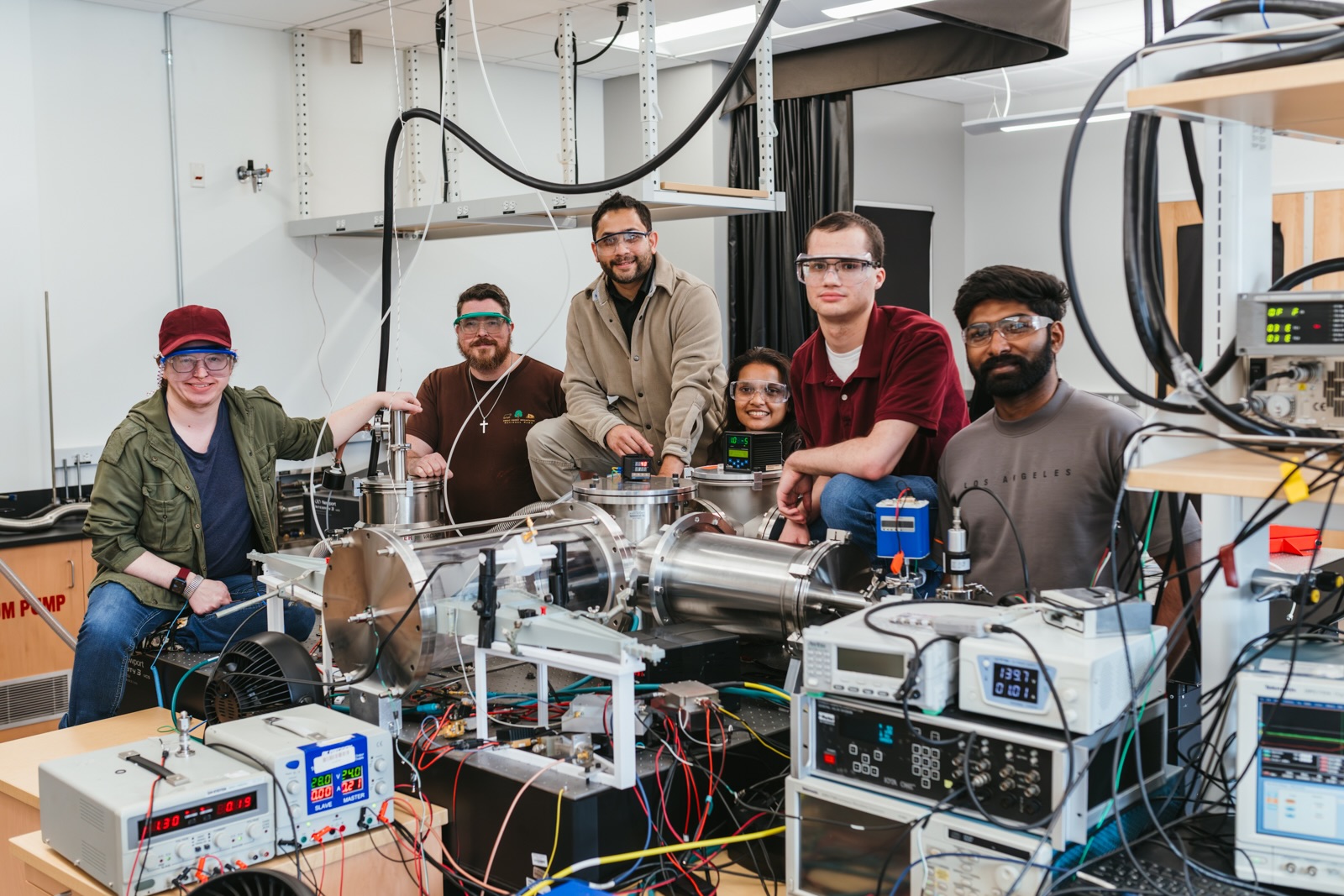
Tennessee Tech University’s Department of Chemistry has added a rare, custom-built research instrument that will expand opportunities for students and faculty while elevating the university’s research capabilities.
The new L-shaped molecular beam Fourier transform microwave spectrometer — or L-FTMW — is one of only a limited number of its kind in the world.
“This instrument elevates Tennessee Tech’s research profile in a meaningful way,” said Ranil Gurusinghe, assistant professor of chemistry. “Labs like this are typically found at major research universities and national laboratories.”
Gurusinghe said Tech may now be home to the only molecular beam FTMW spectroscopy lab in Tennessee — and possibly the first of its kind ever built in the state.
“That distinction represents a significant expansion of the university’s research capabilities,” he said. “It positions Tech to advance work in areas like physical chemistry, astrochemistry, atmospheric science and energy research.”
In addition to research benefits, the instrument is already being integrated into the classroom, giving students hands-on experience with advanced technology.
“Opportunities of this kind are rarely available at the undergraduate level at most institutions.” Gurusinghe said. “Students are not simply learning theory from a textbook. They are gaining firsthand experience with advanced instrumentation and modern research methods.”
The spectrometer allows researchers to study molecules in the gas phase by measuring how they interact with microwave radiation.
“In simple terms, it lets us ‘listen’ to molecules as they rotate,” Gurusinghe explained. “Each molecule produces a unique signal, almost like a fingerprint, that tells us about its structure and properties.”
Michael Aikens, acting vice president for research and economic development, said the spectrometer marks a significant gain for the university’s research enterprise – which reached nearly $48 million in externally funded research for fiscal year 2025.
“This instrument significantly strengthens Tennessee Tech’s research capabilities that expand the scope, depth and impact of discovery across multiple scientific disciplines,” said Aikens. “It expands our capacity to compete nationally in high‑impact areas of research while providing students with invaluable experience.”
Aikens added that, “By working hands‑on with sophisticated instrumentation, students are developing the technical skills, problem‑solving abilities, and outcomes that prepare them for high‑impact careers.”
The instrument was designed and built on campus by a team of graduate and undergraduate students working alongside faculty. Students from chemistry, chemical engineering and computer science contributed to all phases of the project, including design, electronics, programming and data analysis.
“It was a truly interdisciplinary effort in which students were not simply users of the instrument, but builders and innovators,” Gurusinghe concluded.
The team’s work on the spectrometer was recently published in the peer-reviewed journal Review of Scientific Instruments. Read the findings here.