

Tennessee Tech hosts summit to improve state water quality

Tennessee’s rivers, lakes and streams are seeing increased growth of algae and other
plants that leave the water looking and smelling murky and pose a health threat to
humans, aquatic life, cattle and even pets. The culprit – a large list of growing
threats from urban and agricultural runoff, municipal and private wastewater discharges,
animal operations, aerial deposition, and a reduction in natural filters like wetlands.
“The extra nutrients that are going into Center Hill Reservoir are stimulating the
growth of cyanobacteria that can produce taste and odor problems that give the water
coming from our faucets a musty, earthy smell,” said Justin Murdock, director of the
Center for the Management, Utilization and Protection of Water Resources at Tennessee
Tech University. “They can also produce nasty toxins, including neurotoxins and liver
toxins. We see cattle and dog deaths from drinking contaminated surface water in Tennessee
every year from these toxins."
To address this issue, Tech's Water Center recently worked with the Tennessee Department
of Environment and Conservation (TDEC) and the Tennessee Nutrient Reduction Task Force
to gather professionals, policymakers and researchers for a Tennessee Nutrient Summit
on Tennessee Tech’s campus.
“Tennessee Tech has really taken a lead on the issue of nutrient pollution in Tennessee
through the Water Center," said Tania Datta, professor of civil and environmental
engineering at Tech. “We are leading the state in collaboration with our partners
toward better nutrient management and reduction."
The daylong summit, themed "Weaving a Stronger Net to Protect Our Surface Waters,"
brought together representatives from agriculture, stormwater management, wastewater
treatment, conservation groups and state agencies to share strategies for reducing
nitrogen and phosphorus in Tennessee's waters.
TDEC Commissioner David Salyers delivered the keynote address, acknowledging the importance
of the work of the Tennessee Nutrient Reduction Task Force and all partners in the
room. TDEC convenes the task force, which includes representatives from academia,
state and local agencies, wastewater treatment plant operators, the private sector
and nongovernmental organizations. Tech has been an active partner in that effort
since its inception five years ago.
Summit sessions focused on nature-based solutions, agricultural practices, municipal
success stories, water quality monitoring and watershed management. Speakers included
representatives from TDEC, the Tennessee Department of Agriculture, Tennessee Valley
Authority, The Tennessee Aquarium Conservation Institute, multiple municipalities,
and multiple universities including Tennessee Tech, UT Extension, Middle Tennessee
State University and the University of Mississippi, focusing on applying innovative
nutrient reduction strategies.
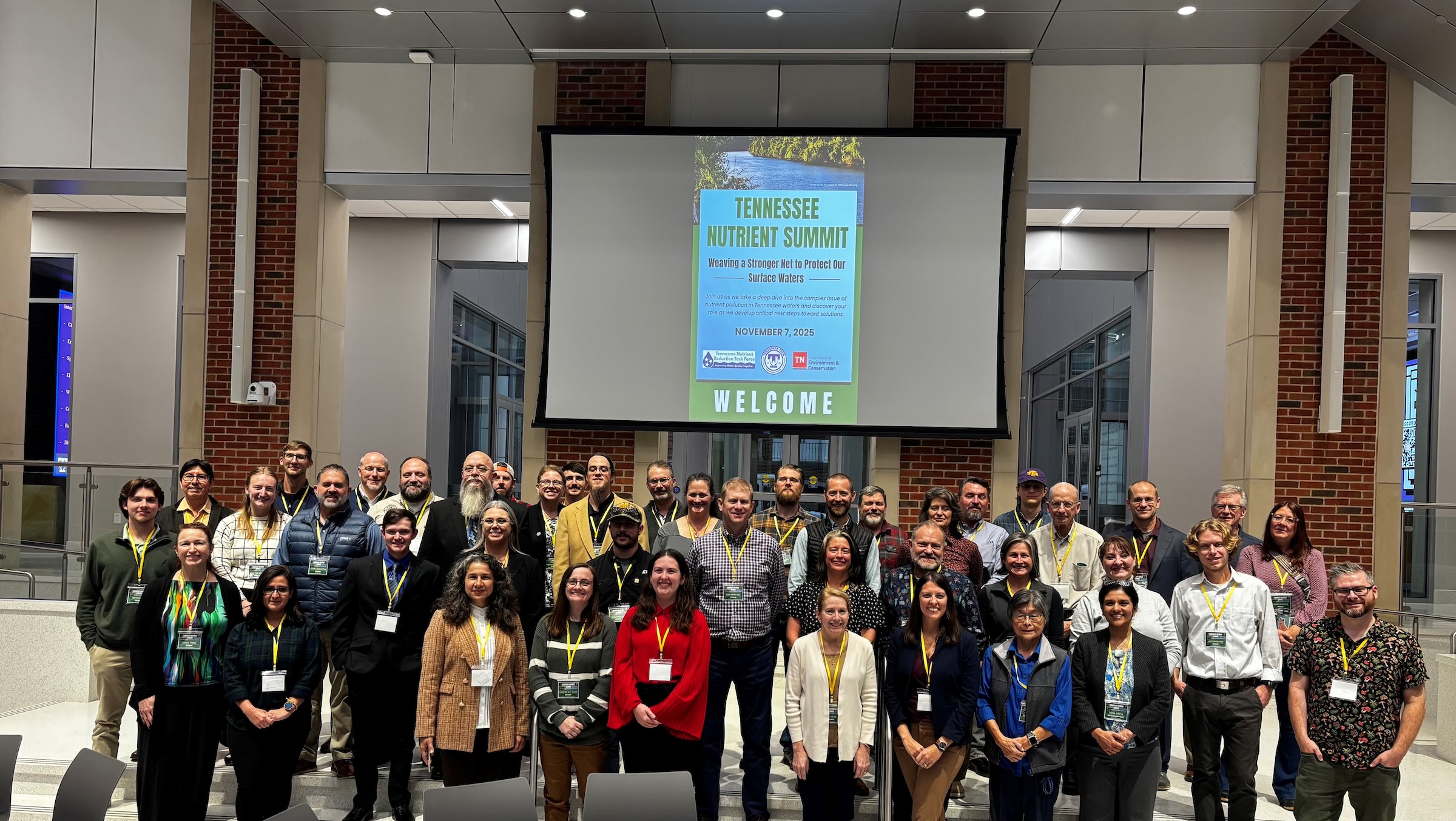
“A lot of times during these types of meetings, you are just listening to a presentation
and there’s not a lot of time to talk to each other and make connections,” Murdock
said. “We planned to allow substantial time for those interactions at this event,
and I think that was a big success connecting partners and exchanging ideas.”
Tech undergraduate students and Water Center staff helped with logistics, registration
and event materials, gaining exposure to a professional network and experience in
assembling an event with many moving parts. Several Tech alumni who now work in the
area of nutrient management also attended.
“To solve the problem, one of the things we need is more dialogue," Datta said. “Those
of us who were at the conference all know about the issues with nutrient pollution,
but through the summit, it was highlighted that we lack in the area of involving and
educating citizens. We do some outreach, but more needs to be done to better involve
people outside of our group about the issue with nutrient pollution and why they should
care about it.”
“This event helped people get the bigger picture of nutrient pollution across the
state,” Murdock added. “Everybody's focused on their sector, or in their county or
in their regulatory area, and seeing what is going on in the rest of the state and
in other sectors helps us see the bigger picture of what's going on and hopefully
get a better idea about how we tackle this together."
Murdock concluded that the event also helped Tech connect to state partners, and praised
TDEC personnel including Karina Bynum, Crystal Warren and Sarah Moore, as well as
Kathy Hawes from TVA, as being an "integral part of the summit planning committee
and making this event happen."
For more information on the Water Center or to get involved, contact Murdock at jnmurdock@tntech.edu or Datta at tdatta@tntech.edu.