

Tennessee Tech receives $2.1 million federal award to establish regional quantum communications testbed
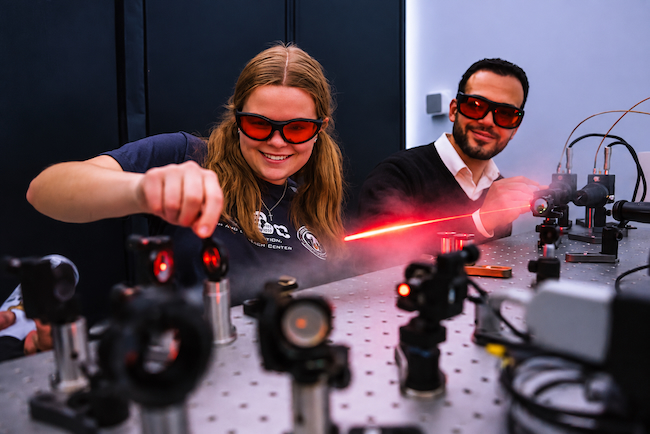
Tennessee Tech University has received a $2.1 million federal award to establish a regional quantum communications testbed between Cookeville and Crossville, creating a research platform for evaluating technologies that could enable next-generation secure quantum networks across Tennessee and beyond.
Funded through the U.S. Department of Commerce’s National Institute of Standards and Technology (NIST), the project will allow researchers to test how quantum information can be distributed and measured across a regional network, helping address technical challenges that must be overcome before quantum networking can be deployed more widely.
Known as Quantum Cookeville–Crossville, the project will establish infrastructure for generating, distributing, monitoring and validating quantum entanglement across geographically separated locations. The testbed will move experimentation beyond a single laboratory, allowing researchers to evaluate emerging technologies under field conditions.
The project’s principal investigator is Muhammad Ismail, director of the Cybersecurity Education, Research and Outreach Center (CEROC), professor of computer science and leader of Tech’s Quantum Information Science initiative. Anthony Skjellum, director of the Advanced Scalable Computing, Extreme Networks & Data (ASCEND) center and professor of computer science, serves as co-principal investigator.
“This award represents an important milestone in Tennessee Tech’s long-term vision for quantum information science,” said Ismail. “Over the past several years, we have made strategic investments in research, education, and workforce development across quantum communications, networking, computing, sensing and post-quantum cryptography. The Quantum Cookeville-Crossville testbed significantly expands our capabilities by providing hands-on access to a real, regional quantum network.”
Building infrastructure for the next generation of quantum networks
Quantum networks use principles of quantum mechanics to distribute quantum information. One foundational technology is quantum entanglement, in which particles share linked quantum properties even when separated by distance. Developing practical networks across longer distances presents challenges including signal loss, environmental changes and precise timing.
The Cookeville–Crossville testbed will incorporate equipment for generating entangled photon pairs, detecting individual photons, stabilizing quantum signals, synchronizing operations across network locations and monitoring system performance.
“Engineers and computer scientists play a critical role in turning scientific discoveries into technologies that can be tested, refined and eventually turned into products that benefit humankind,” said Joseph C. Slater, dean of Tech’s College of Engineering. “That's the contribution we're focused on at Tennessee Tech. Our faculty and students aren't just studying the possibilities of quantum information science; they're developing the systems and infrastructure needed to make those possibilities practical.”
Building on Tennessee Tech’s research strengths
The project brings together complementary expertise from CEROC in quantum networking, quantum cryptography and secure communications and from ASCEND in high-performance computing, advanced networking, scalable systems and quantum information science.
Tech has a quantum communications laboratory and has offered quantum information science coursework through its Department of Computer Science since 2020. Researchers have secured support from the National Science Foundation, national laboratories and other sponsors for work spanning quantum communications, computing, sensing and cybersecurity. The testbed also complements GENESIS, Tech’s high-performance computing system.
“Developing practical quantum networks requires sophisticated computing, networking and systems capabilities to coordinate operations, measure performance and understand how these technologies behave beyond the laboratory,” said Skjellum. “By bringing these areas of expertise together, we can investigate some of the complex challenges that must be addressed as quantum networks advance toward wider deployment.”
Expanding research and workforce opportunities
The testbed will bring specialized quantum networking infrastructure to Tennessee’s Upper Cumberland region and can be expanded as research needs evolve.
“Investments in advanced research infrastructure create opportunities that extend well beyond the university,” said Michael Aikens, associate vice president for research and economic development. “By bringing emerging quantum technologies to the Upper Cumberland, Tennessee Tech is strengthening the region's capacity for research, industry collaboration and innovation. This testbed can help build connections between university research and the technology development and workforce needs that will shape Tennessee's future economy.”
Tech has provided quantum training opportunities to more than 50 undergraduate and graduate students and hosted more than 10 student interns in its quantum research laboratories over the past two years. The testbed will provide additional opportunities for students to work with specialized equipment and experimental methods.
The project is scheduled for completion in September 2028.
For more information about Quantum Information Science at Tennessee Tech, visit www.tntech.edu/research/quantum.