

Alba Frias-De-Diego
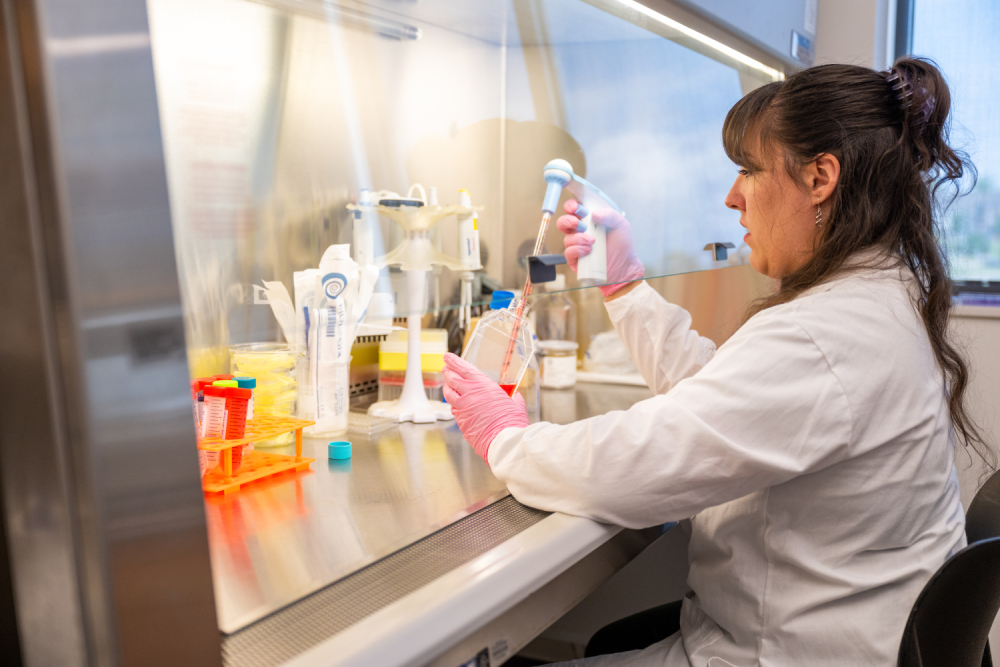
Alba Frias-De-Diego, Ph.D., an assistant professor in the Department of Biology at Tennessee Tech, researches infectious diseases through an approach known as “one health.”
“In a nutshell, my research studies the connections between human, animal and environmental health, and what we can do to treat one, taking the others into consideration,” she said with a smile.
Frias-De-Diego had always had an interest in infectious diseases. So, she decided to get a Ph.D. in virology and a post doctorate in epidemiology and in animal health. She explained, “I really wanted to combine all of those and answer some questions about infectious diseases—and that’s what we are doing in the lab.”
She loves infectious diseases, but she has “a soft spot,” as she said with a laugh, for viruses. There is no consensus as to whether viruses are alive or dead and that particularly interests her.
“I wanted to know how they can get so efficient at infecting and why some viruses can infect some animals but not others. All of these questions about an organism that was not alive were really interesting,” she said.
She strives to inform the public on how to avoid getting infected with diseases, like rabies, that are transmitted through animals. “If we know that rabies is heavily transmitted through the bites of raccoons or bats, we are going to tell people, ‘Hey, if you see a raccoon or bat, don’t go touch it because you might get bitten’,” she said.
Frias-De-Diego collaborates with multiple faculty members across Tennessee Tech, such as environmental sciences instructor Manuel Jara and assistant chemistry professor Kyle Murphy, to develop new ways to detect and treat infectious diseases. “Dr. Jara’s expertise is making it possible to study temporal trends of antimicrobial resistance in the community, and Dr. Murphy synthesizes chemicals that we are currently screening to test as antimicrobials. The best part of collaboration is to address important problems from multiple perspectives,” she said.
Frias-De-Diego teaches cell biology, virology and environmental microbiology. She
said, “I try to get students in the lab to teach them advanced topics like hands-on
research in the lab.” They work with bacteria and try to develop vaccines.
Microbes are constantly changing, so Frias-De-Diego is constantly researching and
innovating. She said, “I came in and there were not a lot of people who did the type
of research that I did.”
Administration and Tech faculty has really helped her along the way. In the future, she hopes to research specific genes that make amphibians resistant to certain diseases.
“We want to see if we can genetically modify vaccines to include that gene for humans to try and fight diseases better,” she said.
She added, “I think you need to keep learning constantly.”