
Overview
- Formal Course Work
- CAE Cyber-AI Pathway
- Undergraduate Coursework
- Graduate Coursework
- Experiential Learning
- Student Workshops
- AI‑Assisted Cyber-Physical Security Competitions
- Student-led Security Operations Center (S‑SOC)
Formal Course Work
CEROC supports a comprehensive AI‑Cyber curriculum spanning both undergraduate and graduate levels, preparing students with foundational knowledge and advanced expertise in cybersecurity and artificial intelligence.
CAE Cyber-AI Pathway within the CS Cyber Concentration
The CAE-CD Program of Study is formally outlined on the Cyber Concentration page of the Computer Science website. The Cyber-AI Pathway is a specialization of this NSA/CAE designation. This pathway provides a route for cyber concentration students who wish to combine their cyber defense studies with artificial intelligence and machine learning applied to security outcomes.
Students complete this pathway by fulfilling all requirements of the Computer Science cybersecurity concentration (CAE-CD) and selecting the designated AI-focused coursework list below, and applying those methods in the senior capstone experience. This structure lets students build demonstrable competency at the intersection of AI and cybersecurity in direct response to workforce demand for practitioners who can develop, evaluate, and defend AI-enabled security systems.
Course |
Title |
Credit Hours |
|---|---|---|
| CSC 4220/5220 | Data Mining and Machine Learning | 3 |
| CSC 4595 | AI for Security Practicum | 3 |
These designated courses, combined with the required coursework of the Cybersecurity concentration and a senior capstone project that applies artificial intelligence to a security problem, define the AICyber Pathway. The pathway’s coursework aligns with and extends the technical Knowledge Units that underpin the CAE-CD-validated Cybersecurity concentration, adding depth in data-driven threat detection, adversarial machine learning, and AI-assisted cyber defense.
Pathway Learning Outcomes
Students who complete the pathway will be able to:
- PLO1: Analyze complex computing problems and apply the principles of computing, cybersecurity, and/or artificial intelligence (AI) to identify solutions.
- PLO2: Design, implement, and evaluate a computing-based solution to meet a given set of computing requirements in the context of the program's discipline.
- PLO3: Communicate effectively in a variety of professional contexts.
- PLO4: Recognize professional responsibilities and make informed judgments in computing practice based on legal and ethical principles.
- PLO5: Function effectively as a member or leader of a team engaged in activities appropriate to the program's discipline.
- PLO6: Apply computer programming, cybersecurity fundamentals, and AI/ML fundamentals to produce computing-based solutions.
Pursuing the Pathway
The Cyber-AI Pathway is open to students enrolled in the cybersecurity concentration of Computer Science. Students who wish to pursue it should consult their academic advisor early to plan their electives and capstone. For more general information about the pathway contact CEROC (ceroc@tntech.edu) or call (931) 372-3519.
Undergraduate Coursework
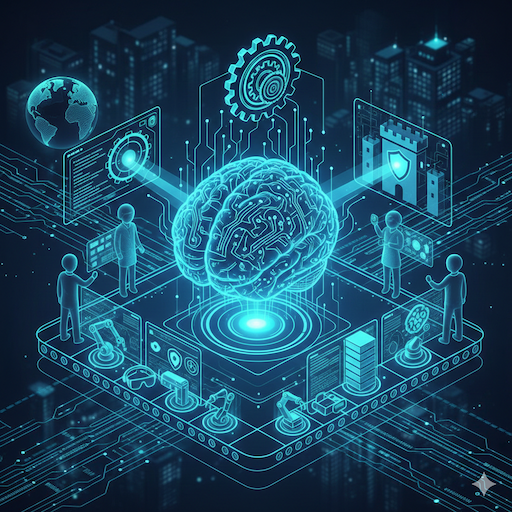
Our undergraduate courses introduce the fundamental principles of data mining and machine learning, providing students with a solid understanding of both supervised and unsupervised learning techniques. Students learn to design, implement, and evaluate a variety of models, including:
- Linear and logistic regression
- Support Vector Machines
- Deep neural networks
- Clustering algorithms
- Principal Component Analysis (PCA)
- Autoencoders and other representation‑learning models
Course projects emphasize applied learning, where students use these models to detect and analyze real‑world cyber threats such as:
- Malware detection
- Social engineering attack detection
- Cyber‑physical intrusion detection
Current efforts are expanding the curriculum to include topics in:
- Generative AI for cyber defense and offense
- Red‑teaming and adversarial prompting
- Defending AI systems against poisoning, evasion, and model manipulation attacks
Graduate Coursework
At the graduate level, courses delve deeper into emerging research areas at the intersection of AI and cybersecurity. Students explore advanced topics such as:
- AI‑assisted cyber defense strategies
- Secure and trustworthy AI model development
- Vulnerability analysis of machine learning pipelines
- Security of AI systems under adversarial conditions
- Applications of AI in cyber‑physical and critical infrastructure security
These courses prepare students for research and development roles by combining theory, hands‑on experimentation, and interdisciplinary problem‑solving aligned with CEROC’s mission.
Experiential Learning
CEROC’s commitment to AI‑Cyber education extends beyond the classroom, offering students immersive, hands‑on experiences that deepen technical skills, foster interdisciplinary collaboration, and connect learning to real‑world cyber challenges. Our experiential learning portfolio includes high‑impact workshops and innovative AI‑Cyber competitions designed to prepare students for the rapidly evolving cyber workforce.
Student Workshops
In May 2025, CEROC co‑organized the Third Annual SHIELD Student Workshop — Strategic Holistic Intrusion Prevention using Multi-Modal Data in Power Systems — held at the RELLIS Campus at Texas A&M University. This workshop was led by:
- Dr. Kate Davis, Associate Professor of Electrical & Computer Engineering at Texas A&M University
- Dr. Muhammad Ismail, Director of CEROC at Tennessee Tech University
SHIELD is part of a multi‑year NSF‑funded research initiative focused on leveraging artificial intelligence to defend modern power systems against cyberattacks — a mission of growing national importance. Each year, the workshop brings together undergraduate students from Electrical and Computer Engineering (ECE) and Computer Science (CS) to explore cutting‑edge topics such as:
- Power systems and grid operations
- Cyber‑physical systems
- Cybersecurity and intrusion detection
- AI‑driven threat modeling
- Social engineering and cyber defense strategies
In 2025, five Tennessee Tech students received travel scholarships to participate, contributing to a total of 20 TN Tech students who have attended the workshop over the past three years. This experience provides students with valuable exposure to research, hands‑on tools, and professional networks in both cybersecurity and critical infrastructure protection.
 2023 SHIELD Team
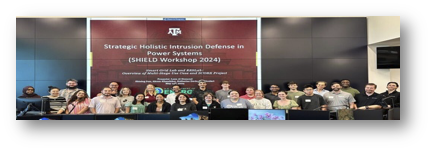
2024 SHIELD Team
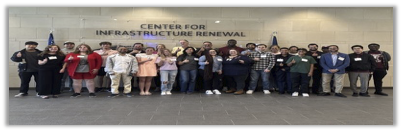
2025 SHIELD Team
AI‑Assisted Cyber-Physical Security Competitions
During the 2024–2025 academic year, CEROC launched its first AI‑Assisted Cybersecurity Competition, a hands‑on, research‑driven challenge that immersed students in the application of artificial intelligence for detecting cyberattacks on cyber‑physical systems. The competition was offered twice—in Fall 2024 and Spring 2025—and was open exclusively to Tennessee Tech students for its inaugural year, with six teams (18 students) participating.
The competition was built around an instructional workshop on cyber‑physical systems and utilized two real‑world testbeds developed by CEROC researchers:
-
-
- A smart power grid
- A drone swarm cybersecurity testbed
-
Students worked with authentic multimodal datasets collected from both the cyber and physical layers of these systems. Over a three‑week period, participants:
-
-
- Utilized Python and modern machine learning workflows
- Developed two AI‑based intrusion detection models (one per testbed)
- Used tools such as ChatGPT to assist with coding and model refinement
- Analyzed operational and attack scenarios, including hardware Trojans on Raspberry Pi devices and cyber intrusions
- Submitted models for scoring against a separate unseen dataset
-
Models were evaluated based on detection accuracy, and the top‑performing team was named the competition winner.
The event also included live demonstrations of both testbeds, including real‑time cyber‑physical attacks and data collection. This gave participants a rare opportunity to observe system behavior under attack and deepen their understanding of cyber‑physical threat dynamics.
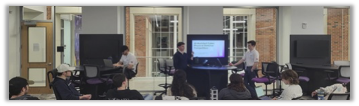
2025 AI-Assisted CPS Competition Briefing
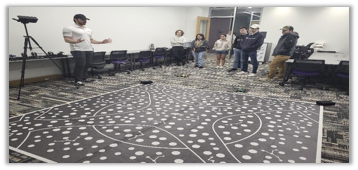
2025 Drone Demonstration
Student-led Security Operations Center (S‑SOC)
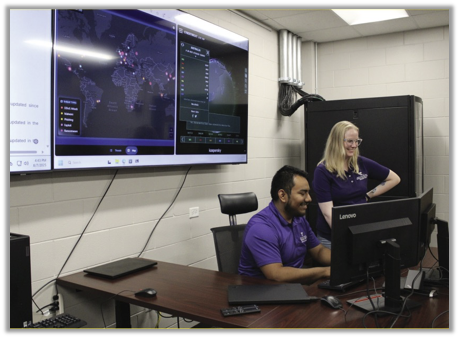
CEROC’s Student-led Security Operations Center (S‑SOC) provides an immersive, real‑world learning environment where students gain hands‑on experience in modern cyber defense. While classroom instruction builds foundational knowledge, it often cannot provide the depth of practical exposure required by today’s cybersecurity workforce. The S‑SOC bridges this gap by empowering students to engage directly in security operations under expert mentorship within a controlled, supportive setting.
At its core, the S‑SOC functions as both a training laboratory and an operational cyber defense space. Students participate in critical activities such as: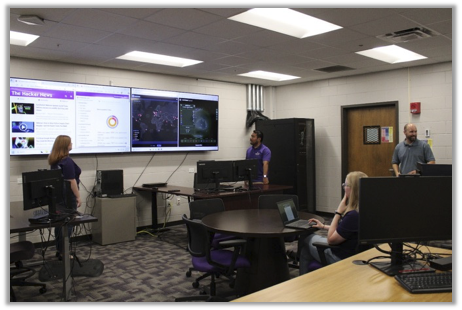
-
- Cyber threat monitoring and detection
- Threat hunting and analysis
- Security communications and reporting
- Log analysis, incident triage, and response simulations
- Operational teamwork and SOC workflow management
These experiences strengthen not only technical competence but also essential professional skills including analytical reasoning, collaboration, communication, and ethical decision‑making.
Integrating Generative AI into SOC Operations
A key innovation within CEROC’s S‑SOC is its growing portfolio of projects exploring the role of generative AI and large language models (LLMs) in supporting modern intrusion detection and SOC workflows. Student teams and researchers work on:
-
- LLM‑assisted threat hunting, where models analyze logs and network telemetry to identify anomalous behavior
- Generative AI for SOC automation, including alert triage, summarization, and incident reporting
- AI‑supported malware classification and behavioral analysis
- Attack simulation and red‑teaming using generative adversarial techniques
- LLM‑driven multi‑modal analysis, integrating network data, system logs, and cyber‑physical metrics
- Hybrid human‑AI workflows, studying how SOC analysts and AI systems can collaborate effectively
These projects position CEROC at the forefront of AI‑enabled cybersecurity operations, helping students gain early experience with tools and methods shaping the future of the SOC industry.
Find us on Social Media




Contact Us
Cybersecurity Education, Research and Outreach Center
Office Hours: Monday–Friday, 8AM–4:30PM CDT
(931) 372-3519 | ceroc@tntech.edu
Street Address:
Cybersecurity Education, Research and
Outreach Center (CEROC)
Ashraf Islam Engineering Building (AIEB) 238
1021 Stadium Dr.
Cookeville, TN 38501
Mailing Address:
Tennessee Tech University
Cybersecurity Education, Research and
Outreach Center (CEROC)
Campus Box 5134
Cookeville, TN 38505