

Tech students to study the history of climate in the Upper Cumberland
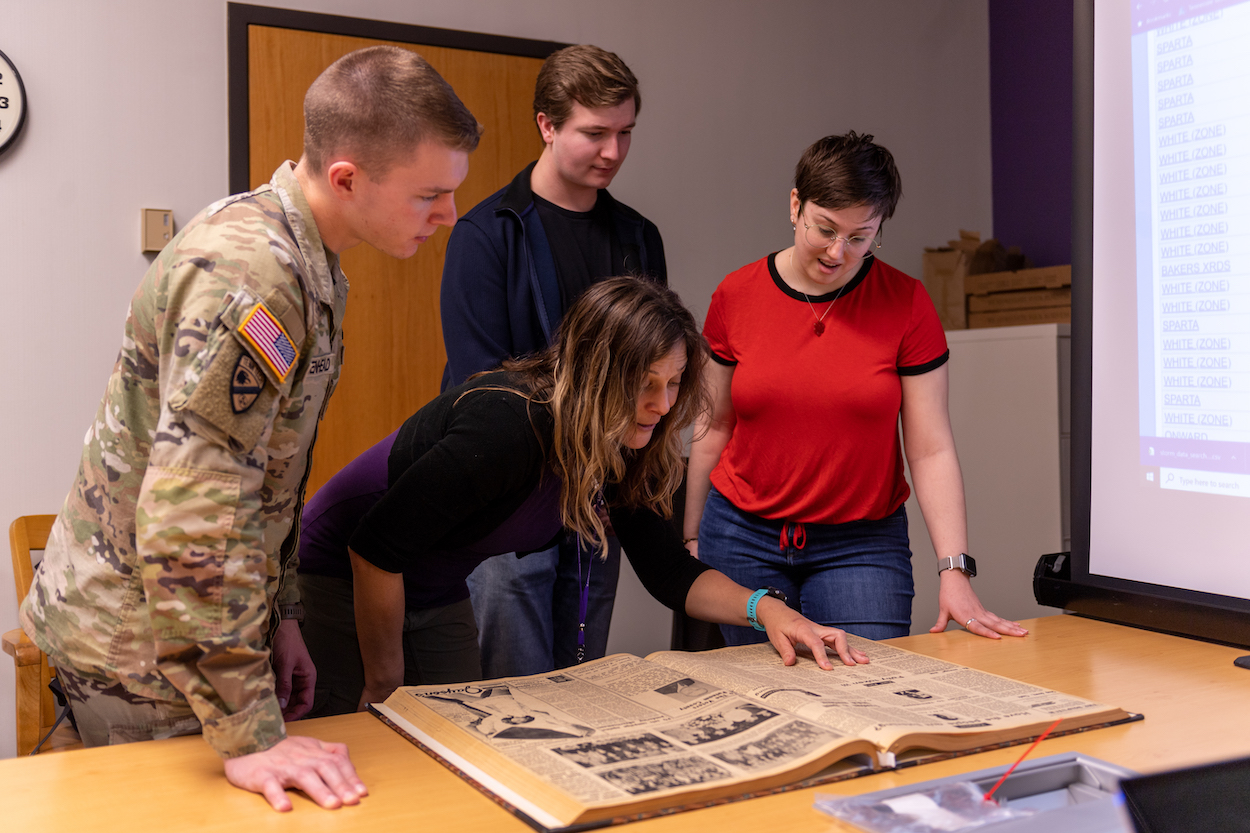
From left, Tech student Taylor Cadenhead; Megan Atkinson, university archivist; and
Tech students Creek Anderson and Theo Kline look through some old newspapers.
Tennessee Tech University students are gaining vital research skills while also creating
a valuable database on the history of climate in the Upper Cumberland. The project
is funded through Tech’s Rural Reimagined faculty grant program, which focuses on
the challenges of rural communities across the state while also giving Tech students
unique learning opportunities.
This research project is being overseen by a group of Tech faculty and staff including
Lauren Michel, assistant professor of earth sciences; Troy Smith, associate professor
of history; Megan Atkinson, university archivist; and Evan Hart, professor of earth
sciences. The faculty have partnered with a select group of students whose majors
include geoscience, history, secondary education and political science.
“There are a lot of people talking about what the future of this region looks like,
but I’d say this study will be a linchpin for many of those future plans,” Michel
said. “The Upper Cumberland has a lot of microclimates. You've got the Plateau, you
have colder areas, you have drier areas, and they can be right next to each other.
There’s a lot of variability. So, if we don’t have a good handle on what the last
100-150 years have looked like, it’s going to be hard to predict what the future is
going to look like.”
The data will also be able to help judge if current climate patterns appear to be
unusual in comparison to historic patterns.
“If we are saying climate patterns are changing, we need to know what the baseline
is. We need to know what they’re changing from,” Hart said.
The students have begun this new project in the Tech archives. They are learning how
to work with microfiche and other historic materials, how to best organize data, time
management and various research techniques. Once they’ve mastered these skills, they
will be sent out to libraries across the Upper Cumberland to collect information from
old newspapers and any other available sources. In addition to this hard data, the
students will be reaching out to members of the community to get first-hand accounts
of their memories of past major weather events.
“It's great to go out and get meteorological information, but I think it's just as
powerful to get the first-hand accounts too,” Michel said. “I think everybody has
a story about that one snow storm or the one tornado. We want to capture voices and
stories that maybe aren't always captured for this community and see what they have
to say.”
Once the data is collected and organized, it will be available online through the
Tennessee Tech Archives and available to the public. The research group believes it
will prove a valuable resource for not only looking into the past but also for looking
toward the future.
“Out west back in the 1800s there were these horrible blizzards two winters in a row,”
Smith said. “Settlers had been there about 20 years and thought they understood the
weather there. But if they had been there for 30 years – or had bothered to ask the
Native Americans there instead of killing them – they would have known that these
big blizzards cycled through every 30 or so years. Because they didn’t know, most
of the cattle died and the industry was crippled – all because they didn’t understand
the local climate cycle.”