

Grant brings Appalachian instructors to Tennessee Tech to learn about 3D printing
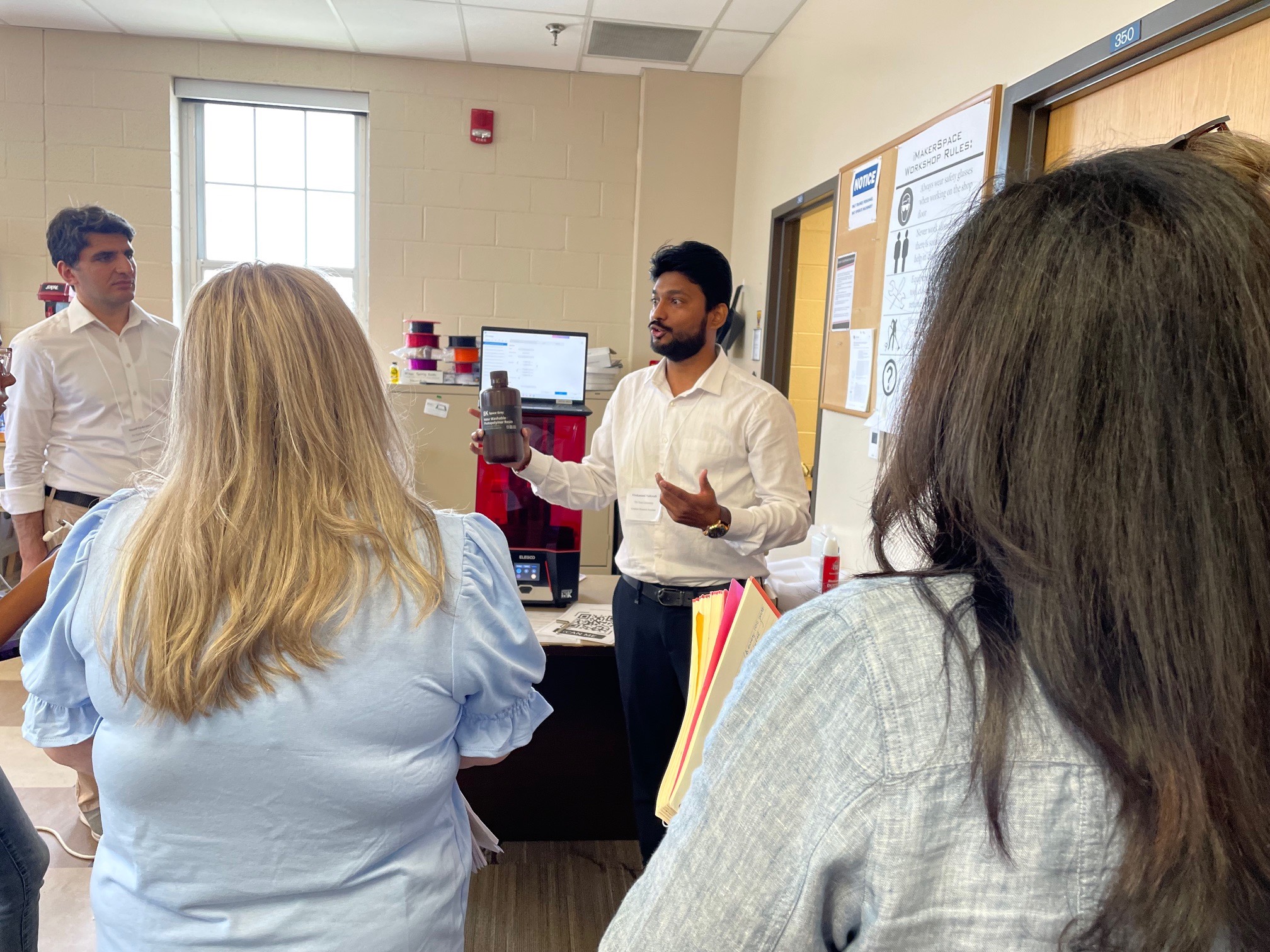
Tech graduate research assistant Vivekanand Naikwadi provides a demonstration of the
vat photo polymerization printer that uses liquid resin to produce 3D designs while
training day participants observe the process.
A Tennessee Tech University professor who specializes in additive manufacturing processes
– or 3D printing – shared expertise and equipment with an exclusive group of other
educators from three states this summer.
Ismail Fidan, a manufacturing and engineering technology professor at Tech, first
teamed up with Somerset Community College in Kentucky in 2019 for a National Science
Foundation grant that provides training and equipment to selected educators in the
STEM fields (science, technology, engineering, math) from the Appalachian regions
of Tennessee, Kentucky and Indiana.
Because of the COVID-19 pandemic, the opportunity for hands-on training was limited
until now.
“Twenty STEM instructors from high schools and community colleges were selected [for
the training] from a pool of about 75 applicants,” he said.
In addition to receiving information about the latest additive manufacturing technology,
each participant also received an equipment package valued around $2,000.
Applicants were required to submit a resume, detailed statement about the instructor’s
current teaching interests and plans for how to implement the workshop information
and equipment in their own classrooms and curricula. All 75 of those application packets
were peer-reviewed, and invitations to the event were made based on the criteria of
need, intellectual merit of practices and potential for broader impact.
“The 20 core winners and four waiting list winners were selected, [and because] one
had a conflict…we picked the first person on our waiting list,” Fidan said.
Several Tech graduate assistants led presentations and demonstrations during the workshop.
Those topics related to operating the 3D printers that attendees would take back to
their own institutions, preparing design files and maintaining the 3D printers.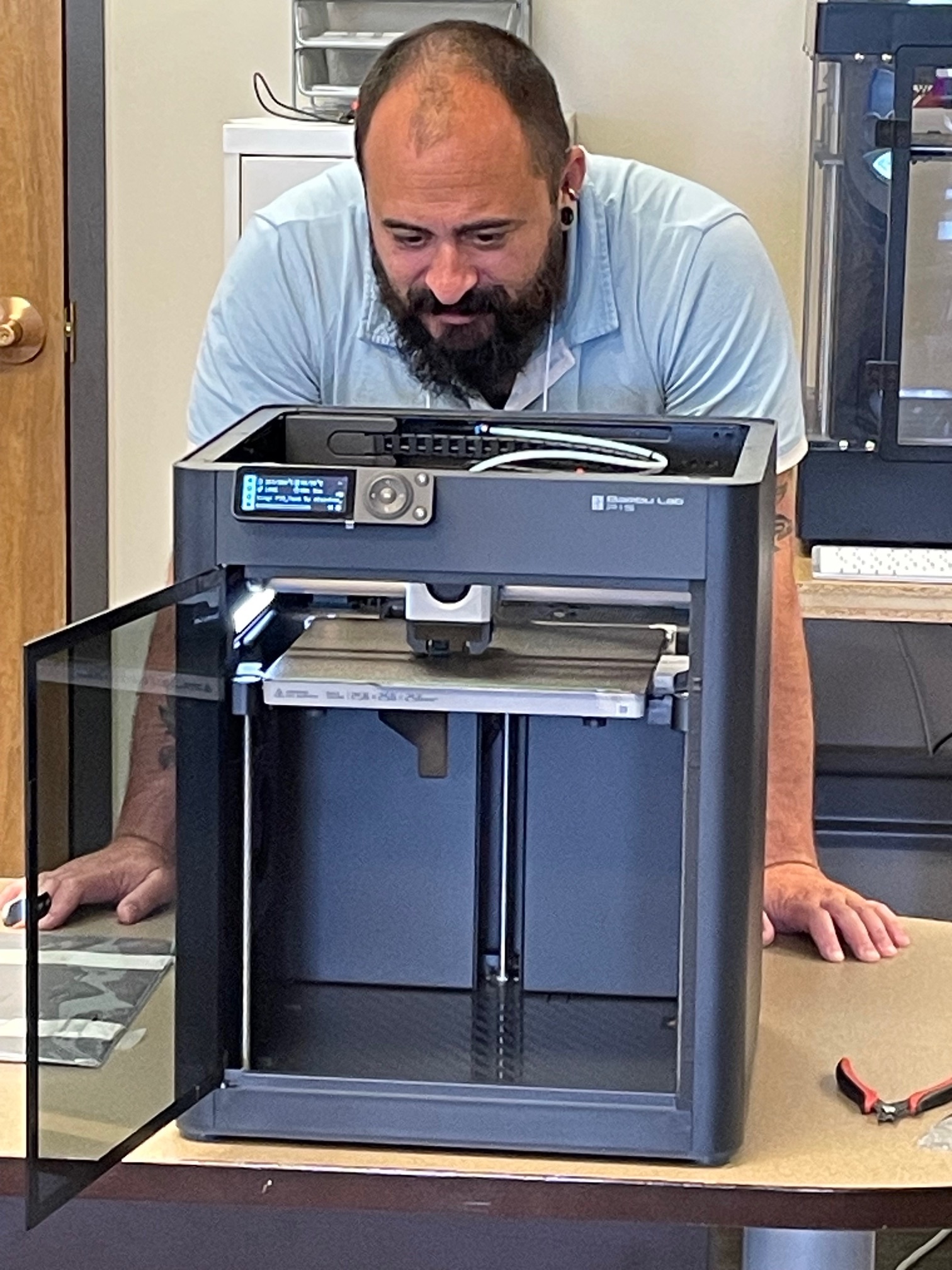
Chris Applegate from Dupont Manual High School in Louisville, Ky., watches the material extrusion printer lay filament to create a 3D design. He was one of 20 instructors selected from high schools and community colleges in Tennessee, Kentucky and Indiana to participate in the recent additive manufacturing – or 3D printing – training day at Tennessee Tech.
Other workshop topics included innovations, entrepreneurial practices, applications,
and tools and technologies to deliver the greatest impact to students in labs and
lectures across the participating institutions.
The equipment package includes a Bambu Lab 3D printer that runs with material extrusion
and a spool of filament for it, an Elegoo 3D printer that runs with vat photo polymerization
and a bottle of resin for it and a toolbox for maintaining both printers.
“They learned about the latest additive manufacturing technology, and they shared
the best practices about their own schools during the day-long training,” Fidan said.
That session kicked off with a message from Michael Tinsley, an assistant vice chancellor
for student success at the Tennessee Board of Regents. He expressed his appreciation
for Fidan, his graduate students and Tech for hosting the session, as well as the
educators from other institutions who attended.
Tinsley said the importance of such trainings is that participating instructors can
take cutting edge knowledge and equipment back to their home institutions, so their
students continue to be engaged and attentive to the learning objectives – and ready
for careers in those fields when they complete their programs of study.
“There’s nowhere else I’d rather be today than right here, supporting the mission
of this workshop,” Tinsley said.
Participants described projects their high school and community college students had
worked on, from rocket launchers and STEM guitar kits to automated medication dispensers
and art department collaborations.
Not only was it an excellent networking opportunity for participating educators to
share their experiences with each other, but it was also a chance for Tech graduate
assistants to gain valuable professional experience as they led some of the information
sessions and demonstrations.
“I am a strong believer that Tennessee Tech has wonderful students, and the university
helps them to flourish so they can lead the workforce of the 21st century,” Fidan
said.
The greatest single success of the event, however, was the positive impact it will
have on instructors and students of other learning institutions across Appalachia,
he said.
“My model is ‘train the trainer.’ With these funds, we are able to train the STEM
educators so they can train their students. The impact is that all our students have
greater future opportunities with the knowledge they gain through these events,” Fidan
concluded.