

Rare Plants Preserved at HTTU
A Record of Tennessee’s Most Vulnerable Plants
Tennessee supports an unusually rich and varied flora. Mountains, plateaus, limestone glades, barrens, wetlands, river scour communities, and other specialized habitats provide homes for plants found in few other places. Some species are naturally uncommon, while others have become rare because of habitat loss, altered land use, invasive species, commercial collection, or changes in natural disturbance patterns.
The Hollister Herbarium preserves physical evidence of this botanical diversity. A preliminary comparison of the HTTU database with the Tennessee Natural Heritage Program’s 2025 Rare Plant List identified at least 100 currently listed rare plant taxa represented by specimens collected in Tennessee.
Each specimen documents a plant’s identity and occurrence at a particular place and time. Historical specimens can establish that a rare species once occurred at a site, while more recent collections can confirm their continued presence. Together, these records help botanists understand plant distributions, recognize changes, identify areas in need of additional surveys, and make informed conservation decisions.
To protect vulnerable populations, this exhibition identifies specimens by county or general region rather than publishing precise collection locations.
What Does “Rare” Mean?
The Tennessee Department of Environment and Conservation classifies rare plants as endangered, threatened, or of special concern.
- Endangered plants are in jeopardy of disappearing as viable components of Tennessee’s flora.
- Threatened plants are likely to become endangered within the foreseeable future throughout all or a significant portion of their range in Tennessee.
- Special concern plants are uncommon in Tennessee or have unusual habitat requirements or scientific value that require continued monitoring.
State rarity does not always mean that a species is rare everywhere. Some plants are secure across much of their global range but occur at only a few locations in Tennessee. Others are rare throughout the world and may exist only in Tennessee or a small portion of the southeastern United States.
The following specimens illustrate the different forms that rarity can take and the importance of preserving physical botanical records.
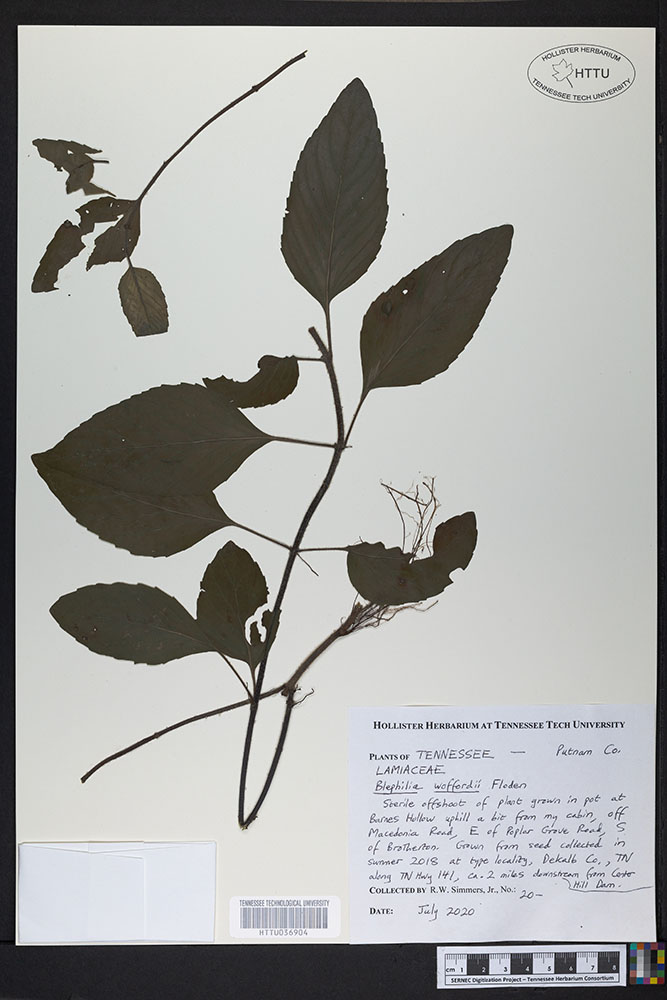
Wofford’s Woodmint
Blephilia woffordii
- Tennessee status: Endangered
- State rank: S1, critically imperiled in Tennessee
- Global rank: G1, critically imperiled globally
- HTTU holdings: 10 digital records associated with DeKalb County
About This Plant
Wofford’s woodmint is among the rarest plants represented at HTTU. It grows in limestone bluffs and woodlands of Tennessee’s Central Basin. Its S1 and G1 ranks indicate that it is critically imperiled both within Tennessee and throughout its entire global range.
HTTU has 10 digital records of this species associated with DeKalb County. Several specimens document plants cultivated from seed collected from a Tennessee population. One specimen collected in July 2020 records a sterile offshoot, while another documents a plant sown in spring 2019.
These specimens show that an herbarium can preserve more than evidence of a wild occurrence. Specimens derived from carefully documented cultivated material can record propagation, growth, variation, and conservation work involving an exceptionally rare species.
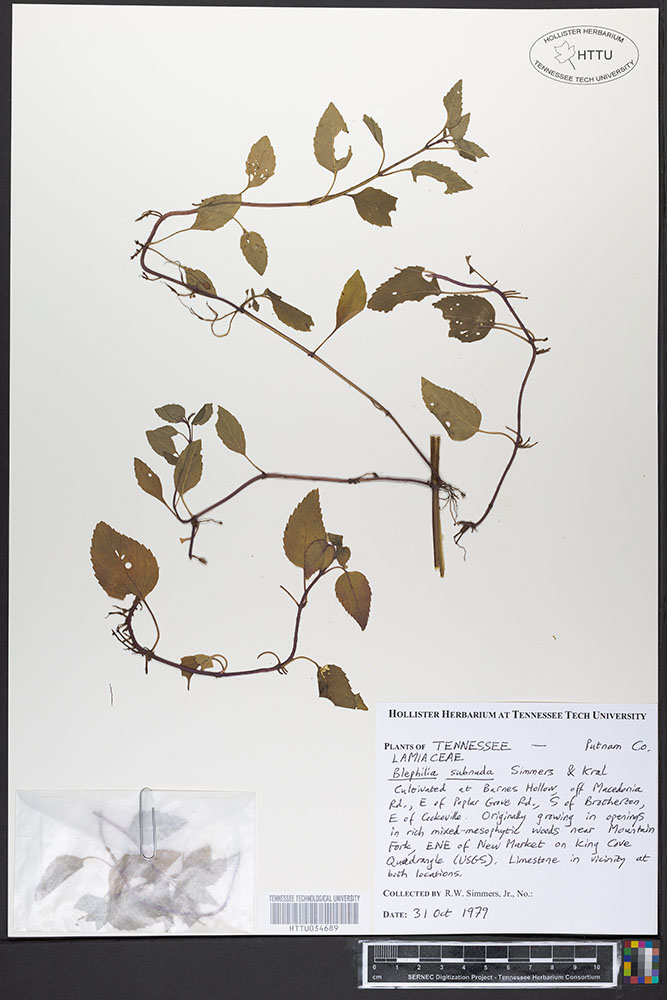
Cumberland Pagoda-plant
Blephilia subnuda
- Tennessee status: Endangered
- State rank: S1, critically imperiled in Tennessee
- Global rank: G1G2, critically imperiled to imperiled globally
- HTTU holdings: Four digital records associated with Putnam County
About This Plant
Cumberland pagoda-plant is a globally rare member of the mint family found in calcareous forests of the Cumberland Plateau. Like other members of the mint family, it has opposite leaves and flowers arranged in clusters around the stem.
HTTU preserves four specimens associated with Putnam County. These specimens are particularly relevant to the herbarium’s mission because they document a globally imperiled plant within the Upper Cumberland region, the geographic center of the collection’s greatest strength.
A preserved specimen allows botanists to examine the plant’s morphology and confirm its identification long after flowering has ended. It can also provide evidence for future taxonomic, ecological, and conservation studies.
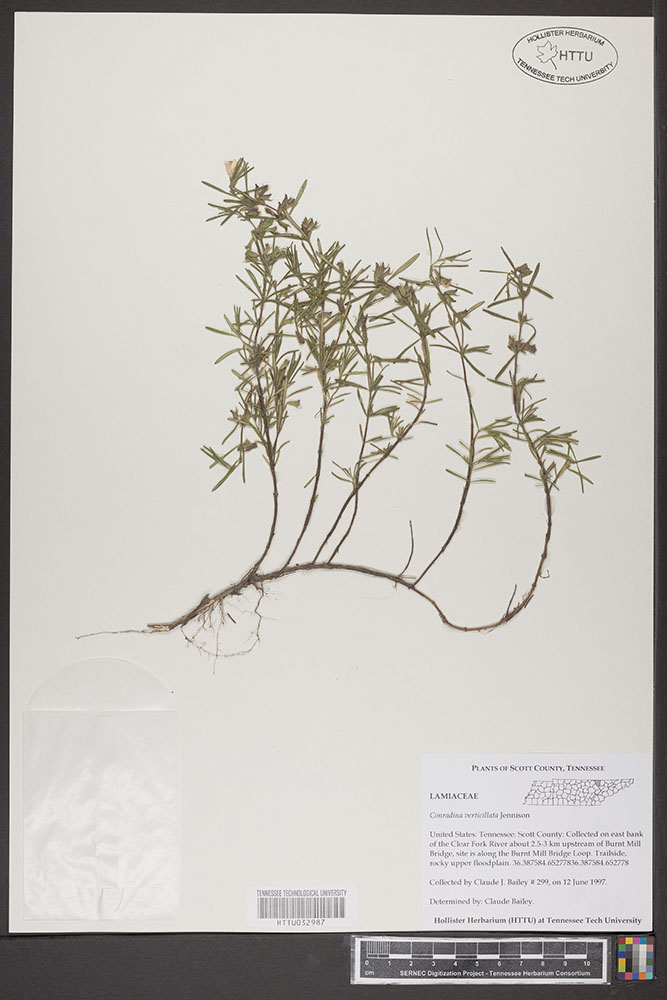
Cumberland Rosemary
Conradina verticillata
- Tennessee status: Threatened
- Federal status: Listed threatened
- State rank: S3, rare or uncommon in Tennessee
- Global rank: G3, vulnerable globally
- HTTU holdings: Three digital records associated with Scott County
About This Plant
Cumberland rosemary is a small, aromatic shrub that grows along sandy, rocky riverbanks and bars in the Eastern Highland Rim and Cumberland Plateau. Despite its common name, it is not the culinary rosemary used in cooking. It belongs to the mint family and is adapted to the open, frequently disturbed habitats created by rivers.
The species is federally listed as threatened. Riverbank modification, recreational use, invasive plants, and changes in natural flooding patterns can affect the specialized habitats on which it depends.
HTTU preserves three specimens associated with Scott County. These records help document the species within the Cumberland Plateau and provide permanent material for confirming identifications and studying its distinctive features.
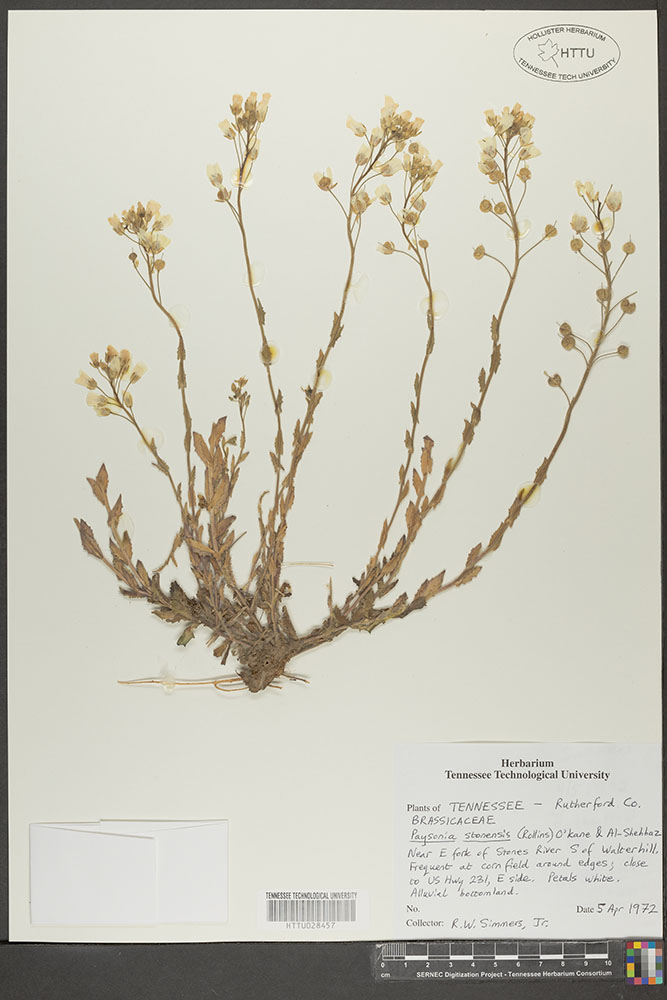
Stones River Bladderpod
Paysonia stonensis
- Tennessee status: Endangered
- State rank: S1, critically imperiled in Tennessee
- Global rank: G1, critically imperiled globally
- HTTU holdings: Six digital records associated with Rutherford County
About This Plant
Stones River bladderpod is one of Tennessee’s endemic plants, meaning that it occurs naturally nowhere else in the world. It is associated with the limestone landscapes of the Central Basin and has been documented in disturbed ground and cultivated fields.
This plant belongs to the mustard family. Its fruits develop into inflated structures that give bladderpods their common name. Because the species has an extremely restricted global distribution, the loss of populations in Tennessee represents a loss to the world’s biodiversity.
HTTU preserves six specimens associated with Rutherford County. These sheets provide a permanent record of the morphology and occurrence of one of Tennessee’s rarest endemic plants.
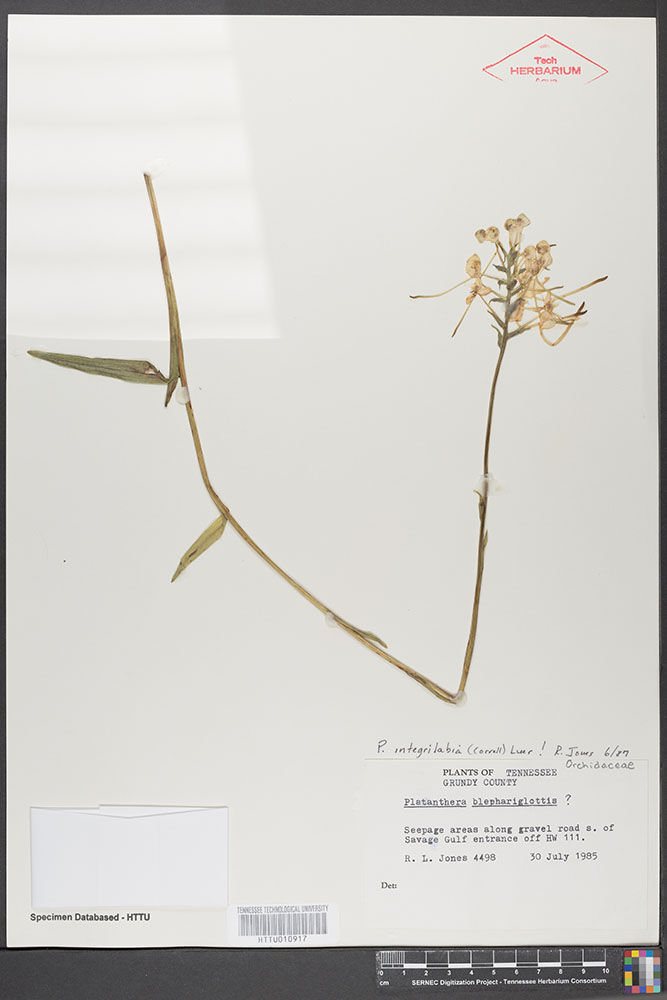
White Fringeless Orchid
Platanthera integrilabia
- Tennessee status: Endangered
- Federal status: Listed threatened
- State rank: S2S3, imperiled to vulnerable in Tennessee
- Global rank: G2, imperiled globally
- HTTU holdings: One digital record associated with Grundy County
About This Plant
White fringeless orchid is a federally threatened species of acidic seeps and stream-head wetlands in the Blue Ridge and Cumberland Plateau. These wetland habitats depend on particular combinations of groundwater, soil, vegetation, and hydrology.
Orchids can be especially vulnerable to habitat disturbance because their survival often depends on relationships with specialized soil fungi. Changes to drainage, water quality, forest cover, or surrounding land use may alter the conditions needed by both the orchid and its fungal partners.
The HTTU specimen associated with Grundy County preserves physical evidence of this rare orchid’s occurrence in Tennessee and provides material that can be reexamined as botanical knowledge and identification methods change.
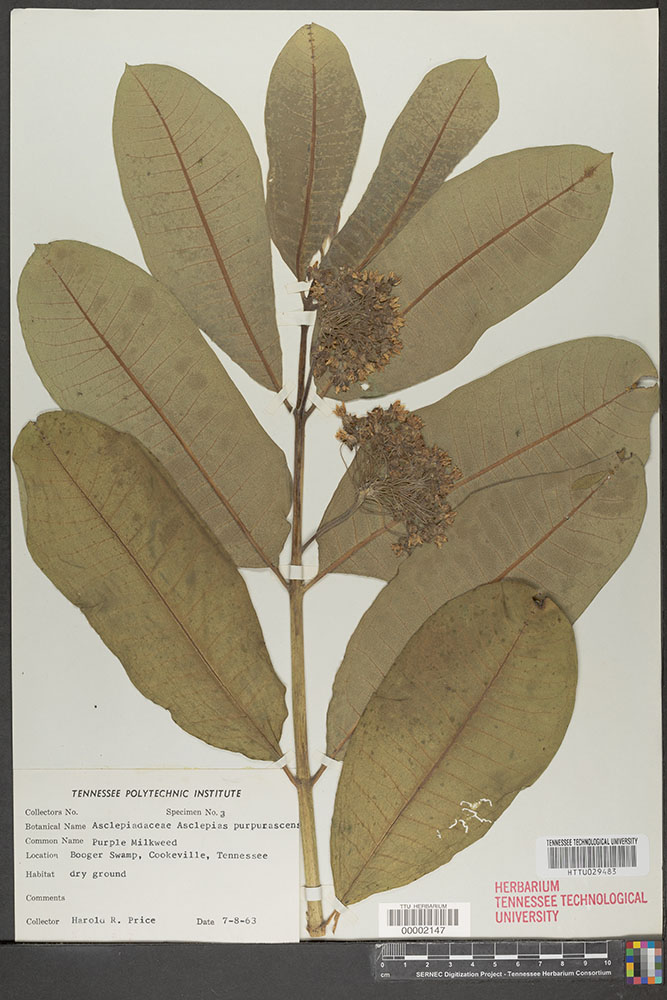
Purple Milkweed
Asclepias purpurascens
- Tennessee status: Special concern
- State rank: S1, critically imperiled in Tennessee
- Global rank: G4G5, apparently secure to secure globally
- HTTU holdings: Six digital records collected between 1963 and 2014
About This Plant
Purple milkweed demonstrates the difference between state and global rarity. The species is relatively secure across its entire range but is critically imperiled in Tennessee. Within the state, it is associated with barrens and other open habitats.
HTTU preserves six Tennessee records, including specimens from Putnam, Jackson, and White counties. The dated specimens range from 1963 to 2014. One 1963 specimen from Putnam County was collected on dry ground, while another was collected along a roadside. A 2014 specimen documents the species in prairie-like habitat with scattered trees.
These specimens preserve more than 50 years of evidence about purple milkweed in Tennessee. They can help researchers evaluate historical distribution, habitat associations, flowering time, and changes in the species’ presence within the state.
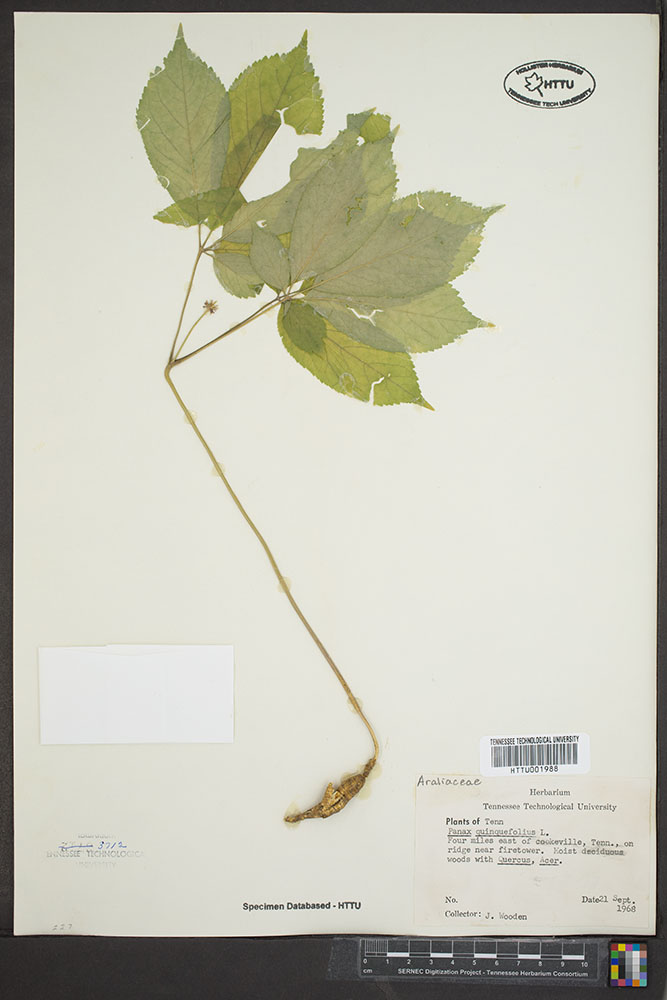
American Ginseng
Panax quinquefolius
- Tennessee status: Special concern and commercially exploited
- State rank: S3S4, vulnerable to apparently secure in Tennessee
- Global rank: G3G4, vulnerable to apparently secure globally
- HTTU holdings: 16 Tennessee digital records
About This Plant
American ginseng grows in rich deciduous forests and has long been harvested for its roots. Demand for wild-collected roots creates a conservation challenge because removing mature plants can reduce reproduction and threaten local populations.
Tennessee identifies American ginseng as a commercially exploited species. This designation recognizes that wild plants are collected in large numbers and that cultivation does not fully replace demand for wild-harvested roots.
HTTU preserves 16 Tennessee records associated with DeKalb, Jackson, Putnam, Overton, and Hickman counties. Dated records range from 1968 to 2001. Their labels describe habitats including moist deciduous woods, moist soil, forest clearings, and wooded sites.
Because collecting pressure can threaten ginseng populations, herbarium records provide valuable historical evidence without requiring researchers to return repeatedly to sensitive sites. Precise locality information should be managed carefully to avoid increasing the risk of unauthorized harvest.
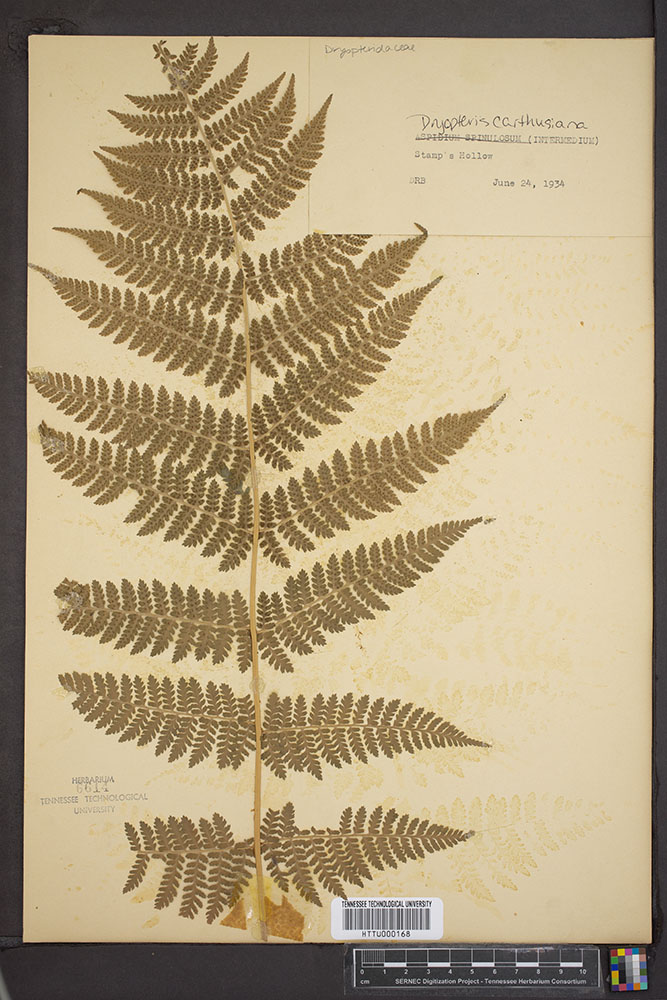
Spinulose Shield Fern
Dryopteris carthusiana
- Tennessee status: Threatened
- State rank: S1, critically imperiled in Tennessee
- Global rank: G5, secure globally
- HTTU holdings: Two Tennessee records collected in 1934
About This Plant
Spinulose shield fern is another example of a plant that is secure globally but exceptionally rare in Tennessee. In Tennessee it is associated with bogs and other cool, wet habitats in the Coastal Plain, Blue Ridge, and Cumberland Plateau.
HTTU preserves two Putnam County specimens collected on June 24, 1934. One is attributed to Dorr R. Bartoo, the fern specialist whose collections helped establish the early Tennessee Tech teaching herbarium.
These specimens are especially valuable because they combine scientific and institutional history. They document a Tennessee occurrence of a currently threatened plant while also representing the early development of the Hollister Herbarium.
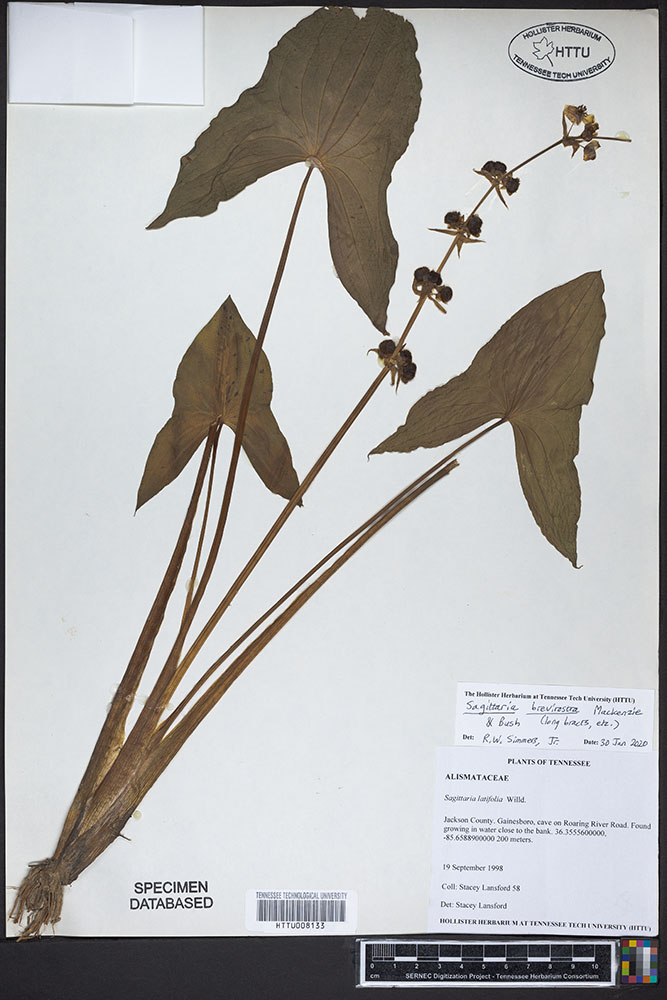
Short-beaked Arrowhead
Sagittaria brevirostra
- Tennessee status: Threatened
- State rank: S1, critically imperiled in Tennessee
- Global rank: G5, secure globally
- HTTU holdings: 21 Tennessee digital records collected between 1962 and 2011
About This Plant
Short-beaked arrowhead is an aquatic or wetland plant associated with swamps, floodplains, marshes, streambanks, lakeshores, and shallow water. Although secure globally, it is critically imperiled in Tennessee.
HTTU preserves 21 Tennessee records associated with Putnam, Jackson, Anderson, Knox, and Lake counties. Dated collections range from 1962 to 2011. Specimen labels describe plants growing in marshes, swamps, wet soil, shallow water, muddy banks, lakeshores, and permanent wetlands.
The number and time span of these specimens make short-beaked arrowhead one of HTTU’s strongest rare-plant records. The collection preserves evidence from different counties, habitats, collectors, and decades, allowing researchers to examine variation and changes in documented distribution.
Many of the specimens were collected by Tennessee Tech students during the 1960s and 1970s. They demonstrate how student collections made for instruction can acquire long-term scientific and conservation value.
Why Herbarium Specimens Matter
A photograph shows what a plant looked like when it was observed, but a herbarium specimen preserves physical material that scientists can examine repeatedly. Researchers can study leaves, flowers, fruits, spores, surface features, and other structures. With appropriate permission, some specimens may also support microscopic, chemical, or genetic research.
Specimen labels are equally important. They may record the collector, date, habitat, associated species, abundance, and location of a population. When that information is entered accurately into a database, researchers can combine records from many herbaria to investigate changes across decades or entire regions.
Rare-plant specimens are especially valuable because collecting them today may be restricted or inappropriate. Existing collections allow scientists to answer new questions without disturbing living populations.
Preserving Records and Protecting Populations
Public access to natural history information supports research, education, and conservation, but rare-species data must be shared responsibly. Exact locality information for highly vulnerable species may be withheld or generalized when disclosure could expose a population to collection, trampling, or other harm.
HTTU provides public access to specimen images and general collection information while working with qualified researchers, conservation organizations, and government agencies that need additional information for legitimate purposes.
The herbarium does not encourage the collection of rare plants. New specimens should be collected only with appropriate authorization, landowner permission, and careful consideration of potential effects on the population.
Continuing the Work
The HTTU database currently contains more than 42,000 specimen records and more than 38,000 specimen images. A preliminary name-based comparison identified at least 100 taxa from the 2025 Tennessee Rare Plant List represented by Tennessee specimens in the collection.
Many HTTU records were created through a regional mass-digitization project and currently contain only skeletal information. Some records lack complete collector names, dates, habitats, county information, geographic coordinates, or updated scientific names. Historical specimens may also be filed under names that have since changed.
Completing and verifying these records will reveal additional rare-plant holdings and make existing specimens more useful for conservation. HTTU is working to transcribe complete labels, standardize collector and geographic information, reconcile current and historical scientific names, add coordinates where appropriate, and correct legacy data errors.
By preserving the physical specimens and improving their associated records, the Hollister Herbarium ensures that evidence gathered by generations of botanists remains available to researchers, students, conservation professionals, and the public.
Explore the Collection
Search HTTU specimen records and images through the Southeastern Regional Network of Expertise and Collections:
Search the HTTU Collection in SERNEC
Researchers and conservation professionals seeking additional information may contact:
Dr. Shawn Krosnick
Director and Curator, Hollister Herbarium
Tennessee Technological University
Pennebaker Hall 207
Cookeville, Tennessee 38505
skrosnick@tntech.edu
931-372-6194
Sources
- Tennessee Department of Environment and Conservation, Division of Natural Areas. Tennessee Natural Heritage Program Rare Plant List 2025. October 2025.
- Hollister Herbarium (HTTU). SERNEC Darwin Core Archive collection export, September 8, 2026.
- Conservation ranks and legal status may change as new information becomes available. Current status information should be confirmed through the Tennessee Division of Natural Areas and the U.S. Fish and Wildlife Service.