
Tennessee Tech, Portobello America collaboration sparks innovation through AI ‘Hackathon’
When global tile manufacturer Portobello America opened its U.S. headquarters in Baxter, just down the road from Tennessee Tech University, leaders hoped to build more than a successful manufacturing footprint.
They envisioned becoming a catalyst for innovation and collaboration in the Upper Cumberland — a vision that recently took shape through a 24-hour artificial intelligence "hackathon" with Tech students.
“We are committed to being a leading brand in design and innovation here in the United States, and this event enables us to foster a culture driven by innovation and collaboration,” said João Oliveira, CEO of Portobello America.
That commitment — paired with the challenges of integrating new technology and attracting technical talent — meant that finding ways to join forces with the university just made sense, said Daniel Mathias, chief information officer for Portobello Group.
“Portobello is geographically located close to Tennessee Tech, and partnering with the university is an obvious way to give students real-life learning experience in our facility and gain new problem-solving perspectives for us. It’s a win-win situation,” he said.
The round-the-clock hackathon, held during Tech’s fall break, challenged student teams to choose from seven real operational problems the company faces daily — including quality control, warehouse logistics, predictive maintenance and materials tracking — and develop viable AI-driven solutions.
Portobello America offered a $2,000 prize package across categories for Best Technology, Best Feasibility and Best Potential Impact, with one team selected as Best Overall.
Jerry Gannod, chair of Tech’s Department of Computer Science, said the collaboration advances the university’s mission to connect classroom knowledge with practical industry experience.
“Events like this embed students in real business needs and create experiential learning opportunities — like co-ops and internships — that strengthen what students learn in the classroom,” Gannod said.
William Eberle, professor of computer science and co-director of Tech’s Machine Intelligence and Data Science (MInDS) Center, said the event demonstrated how artificial intelligence is transforming industries far beyond big tech.
“Every company has its own problems to solve, and AI is everywhere. These kinds of real-world situations teach students how to apply artificial intelligence in a professional setting,” Eberle said.
Mathias said Portobello professionals, Tech students and faculty worked side by side throughout the overnight competition, refining ideas and exploring solutions together.
“It was like a first date,” he joked. “We’d never done anything like this before, but we see this as the first step of what we hope will become a long-term partnership.”
At the end of the event, judges from both Portobello and Tech selected the winning teams:
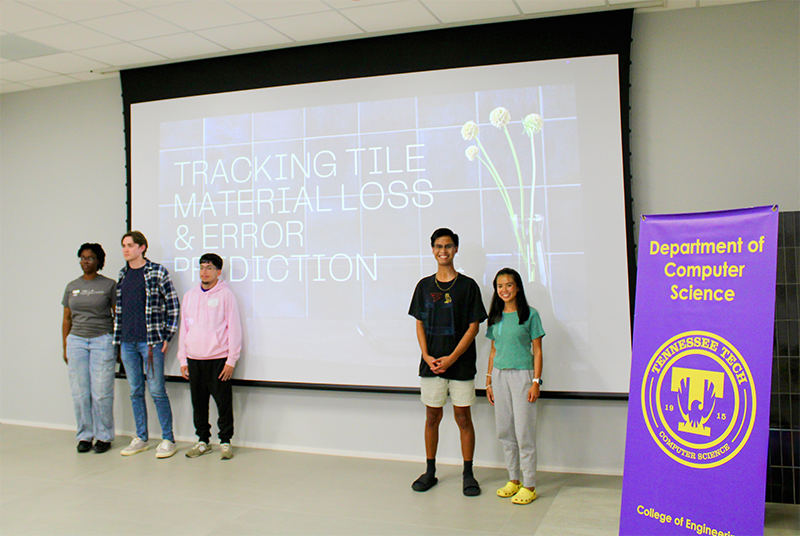
• Best Overall and Best Potential Impact: Team Tile
Kymanie Louis, Kashaina Nucum, Jacob Hernando, Adrian Gonzalez, John Herron
• Best Technology: Pallet Packers
Silas Webber Sylvester, Nolan Patterson, Maximus Jessey, Thomas Robertson, Fengjun
Han
• Best Feasibility: Quantiflow
Vidhula Oviya Vasanthan, Jared Scott, Dalton Sloan, Ashley Porter, Brock Schoenthaler
Team Tile earned top honors for developing an AI-based system that evaluates and flags boxes of tile that may contain broken pieces requiring removal — a solution designed to improve quality control and reduce material loss.
The Pallet Packers team, which won Best Technology, tackled one of Portobello’s most complex logistics challenges: how to stack pallets efficiently and map the best routes for workers moving through the warehouse. The students built a system that tests thousands of possible pallet layouts to find the most stable arrangement, then generates a clear, step-by-step path for workers with less backtracking. They packaged the process into a lightweight interface designed to run directly on warehouse floor machines to improve speed, safety and efficiency.
Quantiflow, the Best Feasibility team, designed an AI-driven materials-tracking system capable of forecast alerts and streamlined reordering to support warehouse accuracy and operational flow.
For many participants, the experience was a crash course in solving problems shaped by real-world constraints.
“We had several impossible problems — logistics, weights, patterns, locations — all baked into one challenge,” said Silas Sylvester of the Pallet Packers team. “We were up until 4 a.m. optimizing the algorithm and trying to make everything fit. It was tough but exciting.”
Across the board, students said the hackathon pushed them to think not only as programmers but also as engineers, business analysts and practical problem solvers while working under high-pressure, real-world conditions.
The collaboration reflects Tech’s longstanding effort to build meaningful industry relationships, Gannod said.
“When we get a partner here in Cookeville or the Upper Cumberland, it becomes very special to us. Portobello America shares that same vision.”
Eberle said the hackathon is already opening new pathways for future projects.
“It gives us a chance to engage with companies that have issues that can be solved with AI — not just through student events like this, but through faculty doing research in AI, robotics and mechatronics,” he said.
Mathias said the greatest strength of the event was the diversity of skills, experiences and perspectives coming together in one space.
“Everyone is learning from each other. Innovation comes from diversity — of ages, of skills, of ideas. That’s what makes this event and this collaboration so powerful,” he said.